Search This Blog

Friday, March 13, 2026

11.4: Labor Movements- Domestic Workers


11.4: Labor Movements- Domestic Workers

Reflection Summary: Labor Movements – Domestic Workers

This reading teaches about domestic workers and their labor struggles in the United States. It shows that many rights workers have today did not come easily. Workers had to fight for them. They organized, protested, and sometimes risked their lives. The reading also explains that these rights were not given equally to everyone. Women of color, immigrant women, Indigenous women, and Black women were often treated the worst. This chapter is important because it helps us understand that domestic workers have always resisted oppression. They were not weak or helpless. They were strong, organized, and politically active.

The reading begins by saying that many workers today may take basic rights for granted. These rights include the 8-hour workday, the end of child labor, and minimum wage. But these protections were not simply given by the government or companies. Workers had to struggle for them. Many workers suffered and died in labor struggles. This reminds me that rights must often be won through collective action.

The reading also explains that even when labor laws were created, they did not protect everyone equally. For example, the National Labor Relations Act of 1935 gave some workers more protections, but many Black workers and other workers of color were excluded. Domestic workers and agricultural workers were often left out too. This shows how racism shaped labor laws. It also shows that labor struggles cannot be understood without thinking about race, gender, and class.

The chapter focuses on domestic workers because they are some of the most exploited workers. Domestic workers often clean homes, cook, care for children, and do other household labor. Many domestic workers are women of color. Many are immigrants. Some are undocumented. Because of this, they often face low pay, abuse, and little legal protection. The reading asks us to look at domestic work through an Ethnic Studies lens. This means we must see how capitalism, patriarchy, racism, and colonialism all affect this kind of work.

One of the strongest messages in the reading is that domestic workers have a long history of resistance. The media often shows them as victims who need rescue. But this chapter tells a different story. Domestic workers have been resisting oppression for hundreds of years. They have built political power. They have demanded respect. They have organized for better pay and laws. This was an important point for me because it changes the way we see domestic workers. It shows them as leaders, not only as people who suffer.

The reading then discusses enslaved Indigenous and African domestic workers. It explains that European colonization brought terrible violence to Indigenous people in the Americas. Indigenous populations were greatly reduced because of colonization, disease, and violence. The Spanish used both Indigenous people and Africans as servants and workers. Indigenous women were forced to do unpaid domestic labor at Catholic missions. They were abused and controlled. But they also resisted.

Some Indigenous women resisted by slowing down their work. Others resisted more openly through rebellion. One example is Toypurina, a Gabrielino Tongva medicine woman, who led an armed rebellion against the San Gabriel Mission in 1785. I think this example is very important because it reminds us that Indigenous women were not passive. They fought back even under violent colonial systems.

The reading also talks about enslaved Black women in early New England society. Black women found ways to resist slavery even though they had very little freedom. They passed abolitionist newspapers in secret. They joined rebellions. They went on strike. Some ran away. Harriet Tubman is one of the most famous examples. Before she became famous for helping people escape slavery, she was also a domestic worker. Tubman led many missions to free enslaved people. Her story shows courage and leadership.

Another important part of the reading is the section about the legacy of slavery after slavery officially ended. Even after the 13th Amendment abolished slavery, Black domestic workers in the South often still worked in slave-like conditions. They were technically free, but the system still treated them unfairly. Black women organized for better pay and clearer job duties. They did not want employers to keep adding more work without more pay. They also created mutual aid groups to help each other survive.

The example of the Washing Society in Atlanta in 1881 stood out to me. Black washerwomen decided on a standard rate for their labor. They organized together and quickly gained thousands of members. They even threatened a general strike. The government and employers tried to stop them with arrests and fines. But their movement spread to other states. This shows how powerful domestic workers were when they acted together. It also shows that Black women were key labor leaders, even though history often ignores them.

The reading explains that during the Great Depression, labor protests led to some important labor laws. These laws gave workers protections like the 8-hour day and overtime pay. But domestic workers and agricultural workers were left out. These workers were mostly African American and Latina women. This again shows how racism shaped who received protection and who did not. It made me think about how laws can seem fair on the surface, but still leave out the people who need them most.

The section about Native American children was also very painful to read. The government took Indigenous children away from their families and sent them to Indian Boarding Schools. These schools tried to destroy Indigenous culture. Native girls were trained for domestic work like ironing, cooking, and cleaning. They were told they were only fit for low-level labor. Some girls were sent to white homes to work as live-in domestic workers. This was another form of control and exploitation. It also shows how colonization and labor exploitation were connected.

The reading says this practice continued until 1978, when the Indian Child Welfare Act gave Native parents more power to resist the removal of their children. This is important because it reminds us that these harms are not only from the distant past. They lasted for many generations.

The chapter also talks about domestic work in the borderlands. Indigenous and Mexican women resisted slavery, kidnapping, and bad working conditions for many years. After the U.S. took more land in 1848, borders changed, and many Mexican people suddenly found themselves living under U.S. rule. They lost land and were pushed into low-paid labor, including domestic work.

Mexican domestic workers were often paid much less than white domestic workers for the same work. In 1933, Chicana domestic workers created the Asociación de Trabajadoras Domésticas in El Paso. They organized 700 workers and demanded higher wages. Employers tried to divide workers from El Paso and Juarez by paying some even less. They also tried to deport one of the leaders, even though she was a U.S. citizen. But the workers still won some of their demands. This part of the reading shows how employers use borders, wages, and immigration threats to control workers. At the same time, it shows that workers still found ways to organize and resist.

One of the most powerful parts of the chapter is about domestic workers in the Civil Rights Movement. Many history lessons focus on famous leaders, but this reading shows that Black domestic workers were central to the Montgomery bus boycott. Most bus riders in the South were Black domestic workers. They faced abuse and danger on buses every day. Some drivers were violent and armed.

The reading says Georgia Gilmore had already stopped riding the bus before Rosa Parks’ arrest. Domestic workers walked, organized carpools, passed out flyers, and raised money by selling food. Their labor helped make the boycott successful. This is very important because it changes the usual story of the Civil Rights Movement. It shows that poor Black women workers were leaders in the movement, not only followers. Without them, the boycott may not have succeeded.

I think this is one of the strongest lessons in the reading. Many of the people who do invisible labor are also doing important political work. Domestic workers were moving the Civil Rights Movement forward while also surviving hard working conditions.

The chapter then moves to more recent organizing. In the 1970s and 1980s, some African American women began to move out of domestic work because of civil rights reforms. At the same time, many immigrant women from the Caribbean, the Philippines, Mexico, and Central America entered domestic labor. Many came because of war, poverty, U.S. intervention, and immigration changes. They had few job options and often lacked citizenship rights.

The reading explains that many immigrant women brought organizing experience from their home countries. This helped strengthen the domestic workers movement. Workers centers became important places where laborers could get support, organize, and fight wage theft and abuse. I think this shows how immigrant women are not just workers, but also organizers and leaders.

The example of Mujeres Unidas y Activas in the Bay Area was inspiring. It is a grassroots group led by Latina immigrant women. It works for personal transformation, community power, and social and economic justice. The group helped push for the California Domestic Worker Bill of Rights, which became law in 2016. This shows that local organizing can create real legal change.

The section on Filipina domestic workers also helped me understand the global side of this issue. The reading explains that U.S. colonialism and militarism shaped the economy of the Philippines. Because of poverty and lack of jobs, many Filipinx people work abroad as Overseas Filipino Workers. Many send money home to support their families. Some are exploited, trafficked, or forced to work in abusive conditions.

The Damayan Migrant Workers Association in New York organizes with low-wage migrant workers. They fight labor trafficking and abuse. This part of the reading is important because it shows that domestic worker struggles are not only local. They are also transnational. Global systems like imperialism, neoliberalism, and patriarchy help create the conditions for exploitation.

The chapter ends with the Domestic Workers Bill of Rights and the National Domestic Workers Alliance. In 2007, domestic workers from around the country gathered in Atlanta and formed the NDWA. They helped pass the first comprehensive domestic workers bill of rights in New York in 2010. Later, other states passed similar laws. In 2019, the NDWA introduced a federal Domestic Workers Bill of Rights. Their organizing centers anti-Black racism, immigration injustice, and other systems of oppression.

This final section gave me hope. It shows that domestic workers are still organizing today. They are building multiracial alliances and demanding change. They are continuing a long history of resistance.

My reflection on this reading is that domestic workers are some of the most important but most ignored people in labor history. They have done essential work in homes, families, and communities. At the same time, they have been underpaid, disrespected, and excluded from protections. But they have never stopped resisting. From Toypurina to Harriet Tubman, from washerwomen in Atlanta to immigrant worker centers today, domestic workers have shown courage and strength.

This reading also helped me see how labor struggles connect with race, gender, immigration, and colonialism. Domestic work is not only about jobs. It is also about power. It is about who is considered valuable and who is treated as disposable. Ethnic Studies helps us see these deeper connections.

In conclusion, this chapter shows that domestic workers have always been central to labor movements and social justice struggles. They fought slavery, colonialism, racism, patriarchy, and economic exploitation. They organized across generations and communities. Their history is a history of resilience, leadership, and change. I think this reading is very important because it gives respect to workers whose contributions are too often forgotten.

Worker-led Struggles


Institutionalized rejection of difference is an absolute necessity in a profit economy which needs outsiders as surplus people.

- Audre Lorde, 1998


Although many workers in the U.S. today might take for granted the 8-hour work day, the end of child labor and slave labor, minimum wage, and more, these basic workers’ rights weren’t simply handed down from our government, "generous" companies, nor bosses. These were hard-won rights that took decades and unfortunately many lives. Even when workers’ rights were won, they weren’t always equally applied, such as when the National Labor Relations Act was passed in 1935, and African Americans and other workers of color were largely excluded from such legislative protections until decades later. Lately however, even those important wins stemming from our rich and violent history of labor struggles have been taken away due various structural changes, including the rise of mega-corporations, the consolidation of wealth, deindustrialization, and the continued hyper-exploitation of contract, part-time, undocumented, immigrant, and female workers.

Along with the capitalist exploitation of the masses (intersecting with white supremacy and colonialism), there are worker-led struggles whose legacies have most definitely made an impact and continue to influence current workers’ movements. In this section, we’ll examine the domestic workers labor struggle through an Ethnic Studies lens. In the next section, agricultural workers.

Domestic Workers

Paramount to understanding the significance of labor movements, we should start by examining the experiences and movements of the most exploited workers, who often end up being women of color, including colonized women, enslaved women, and immigrant women of color.

In this section, we’ll examine the political impact made by domestic workers movements. As pointed out by Premilla Nadasen in her book, Household Workers Unite (2015), social movements and activism by domestic and household workers are often ignored in the media, overshadowed by narratives of helplessness and domestic workers needing rescue. Contrary to popular discourse, women of color domestic workers have resisted oppression for hundreds of years, from colonization to slavery to modern-day systemic racism, patriarchy, and capitalism. Through it all, they have attained political power, commanded respect in their work, and continue to make significant legislative, economic, and social transformations for domestic workers.

Sidebar: "A History of Domestic Work and Worker Organizing" Timeline

Take a look at the "A History of Domestic Work and Worker Organizing" digital timeline by the National Domestic Workers Alliance and activist-scholars Jennifer Guglielmo, Michelle Joffroy, and Diana Sierra Becerra. Using vibrant images and informative text, the timeline offers an in-depth examination of the rich history of domestic workers "resilience and resistance."

Enslaved Indigenous and African American Domestic Workers

We start with the impact of European colonization on indigenous populations of the Americas and the congruent enslavement of people from Africa. Although approaching the first Europeans with generosity and peace, Indigenous peoples were met with perverse violence and cruelty, their estimated population of 100 million slashed severely by 95% within the first 200 hundred years of colonization. By the 1600s, the Spanish were prominent settler-colonists of the Americas and had coerced, often violently, both Indigenous and African populations into a permanent servant status. This included unpaid domestic labor at Catholic missions, where Indigenous women were abused. They resisted in both covert methods, such as slowing down work, or more openly by leading revolts and setting missions on fire. One such resistor was Toypurina, a Gabrielino Tongva medicine woman, who led an armed rebellion against the San Gabriel Mission in 1785 (Domestic Workers Make History, 2022, 03:02).

Amongst early New England settler-colonists, the developing society began to rely on enslaved African labor by the mid-18th century. Tera W. Hunter, professor of American History and African American Studies, noted that enslaved Black women were creative in “seiz[ing] time…which they weren’t given” (Domestic Workers Make History, 2022, 03:59). This included passing around abolitionist newspapers in secret, joining rebellions, going on strikes, or running away from slave-owners. One of the most well known household names for abolitionists was Harriet Tubman, who was also a former domestic worker. Famous for leading some 13 expeditions to free others from slavery, Tubman also led African American union soldiers to free over 700 enslaved people in South Carolina in 1863 (04:45).

Legacy of Slavery Among Domestic Work in the South

Despite slavery being abolished through the 13th amendment, Black domestic workers continued to labor in slave-like conditions. Although technically free people, the legacy of slavery remained steadfast (Domestic Workers Make History, 2022, 05:47). Black domestic workers organized for better pay and set parameters around their labor, such as insisting that if they were hired to be a cook, they should not have to clean the house or become a child nurse. They created mutual aid groups and pooled their resources so that they could support one another economically during times of need.

In 1881, the largest domestic workers strike of the 19th century took place in Atlanta, Georgia, where a group of 20 Black washerwomen collectively decided on a standard rate for their work. They named themselves the Washing Society and within three short weeks, they had already recruited 3,000 members (including Black cooks and housekeepers, and Irish immigrants). They threatened to go on a general strike and were met with arrests and fines as retaliation. Regardless, the movement spread and washerwomen struck across various states. In North Carolina, strikers declared: “Let the white people learn to serve themselves” (Domestic Workers Make History, 2022, 09:30).

By the 1930s when the Great Depression hit, workers and unemployed people demonstrated on the streets, demanding labor protections, soon compelling the federal government to pass some of the first labor protection laws. Professor Nadasen stated how 8 hour days and overtime pay were all a part of labor laws “that established a broad safety net for workers across the country.” Yet two categories of workers were excluded from such legislation: agricultural and domestic workers, populations that disproportionately included African American and Latina women, “so racism played a big role in how labor protections were allocated in the 1930s” ((Domestic Workers Make History, 2022, 10:30).

Kidnapping Native American Children

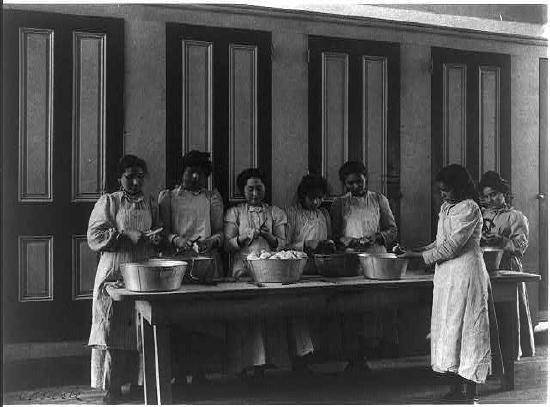
Native American girls at a cooking class
Figure Carlisle Indian School, Carlisle, Pa. Cooking class. Frances Benjamin Johnston Photograph Collection, Library of Congress, Prints & Photographs Division, Reproduction number LC-USZ62-26783. (Photo by Frances Benjamin Johnston)

From the late 19th century into the mid-20th century, the practice of kidnapping Indigenous children from their families and imprisoning them at government sponsored, so-called Indian Boarding Schools was common practice. The motto “Kill the Indian, Save the Man” was used to justify the violent and abusive treatment endured by 20,000 Native children at these schools, with the purpose of destroying Indigenous cultures and families. Native girls were tracked to provide domestic work, trained to do ironing, cooking, and housekeeping. Brenda Child (Red Lake Ojibwe) wrote, “Indian students in the government boarding schools were constantly bombarded with the notion that they were best suited for menial labor” (Guglielmo, et al., 2021, “Menial Labor as Civilization”). Outing programs placed Native teen girls to be live-in domestic workers in white homes across the southwest in cities like Los Angeles, Tucson, and San Francisco. The practice of separating Native American children from their parents and families continued until 1978, when the Indian Child Welfare Act gave Native American parents the legal right to resist their child’s placement in Indian Boarding Schools. See also "Assimilation, Boarding Schools and Adoption" under Chapter 4.

Domestic Work in the Borderlands

Indigenous and Mexican women of the borderlands had been resisting slavery, kidnappings, and deplorable working conditions as domestic workers for over 100 years. Workers fought back in various ways, from work stoppages to leaving ranchos, to violent insurrections like the one at Rancho Jamul near San Diego, California in 1837 (Guglielmo, et al., 2021, “The Rancho Jamul Raid”). After U.S. conquest (1848) led to a remapping of borders, Indigenous populations faced land-theft, removal, containment, and surveillance. Chicanx people now on U.S. territory lost property as well, being “relegated to low-paid, low-status work, such as domestic and agricultural labor” (“We Didn’t Cross the Border, the Border Crossed Us”).

Mexican domestic workers were paid a third of what white domestic workers (largely European immigrants) were paid for the same work. In 1933, Chicana domestic workers established the Asociación de Trabajadoras Domésticas (The Association of Domestic Workers), organizing 700 domestic workers to demand higher wages. By the 1930s, almost all domestic workers were Mexican women from El Paso, Texas or Ciudad Juarez, just south of the border in Mexico. Employers in Texas would pit domestic workers from El Paso and Juarez against one another through low wages (Guglielmo, et al., 2021, “On Strike in El Paso”). If a worker in El Paso wanted fair wages, the employer would simply hire women from Juarez and pay them even less.

Despite the perpetual threat of deportations looming over workers, domestic workers continued to organize. When the Asociación de Trabajadoras Domésticas organized a strike, employers tried to have one of the leaders deported, even though she was a U.S. citizen. But after other unions joined in support, the employers conceded and met the strikers’ demands, agreeing to pay domestic workers a dollar more per week.

Domestic Workers in the Civil Rights Movement

The modern Civil Rights Movement in the U.S. is recognized as having started with the arrest of Rosa Parks and the Montgomery bus boycott. More than a half century later, much of the labor and leadership by African American women have been erased from historic accounts of this movement, including the role of Black domestic workers in bus boycotts. In fact, most bus riders in the South were Black domestic workers, and they were the ones to initiate bus boycotts to bring an end to racial segregation. Depending on public transportation to get to their place of employment, domestic workers faced abuse and patronizing treatment by drivers. If the women didn’t give up their seats for a white passenger, they risked getting kicked off the bus, arrested, hit, or even killed for their resistance, as some drivers carried weapons (Guglielmo, et al., 2021, “The Struggle Against Everyday Violence”).

Georgia Gilmore, a cook and maid, had stopped riding the bus in protest of her mistreatment, years before Rosa Park’s famous arrest. Of the boycott, Georgia said,

This new generation had decided that they just had taken as much as they could….After the maids and the cooks stopped riding the bus, well, the bus didn’t have any need to run. And so instead of riding the bus, they would walk. And then they began to form a carpool (Domestic Workers Make History, 2022, 16:16).

Domestic workers organized their friends to join the boycott, passed out flyers, and fundraised by selling pies and other meals, leading to a successful boycott of over a year when on November 13, 1956, the U.S. Supreme Court upheld a lower court’s ruling that segregation on buses violated the Fourteenth Amendment. According to Professor Nadasen,

The Montgomery Bus Boycott was the moment that signifies the ways in which domestic workers were really the leaders of the boycott. And without their support, without their involvement, the Montgomery Bus Boycott, and much of the Civil Rights Movement would not have been possible (2022, 17:25).

The Rise of Workers Centers and Domestic Worker Organizing Today

Also during the 1970s and '80s, African American women began shifting out of domestic labor, as job markets started to slowly open up due to reforms that came out of the Civil Rights Movement. In the aftermath of U.S. wars, occupations, changing immigration laws, and interventions in Asia and Latin America, millions were uprooted from their homes resulting in migrations to the United States (Domestic Workers Make History, 2022, 28:05). With limited access to citizenship, women of the Caribbean, the Philippines, Mexico, and Central America were starting to find scarce opportunities for employment other than domestic work. Linda Burnham of the National Domestic Workers Alliance notes that because some of these women came as experienced organizers from their countries of origin, the domestic workers movement evolved to be primarily led by immigrant women. With this came workers centers - places that addressed “particularly high degrees of exploitation” that the largely undocumented immigrant labor force faced, such as wage theft and “absolutely no rights to the basics” (29:20).

Mujeres Unidas y Activas (MUA) was an early workers center, established in the Bay Area. One of their co-founders, Clara Luz Navarros, used to be a nurse and community leader in El Salvador, fled political persecution, and brought her skills to the San Francisco Bay Area (Domestic Workers Make History, 2022, 30:31). Still active today, MUA is a grassroots organization led by Latina immigrant women advocating for “personal transformation and building community power for social and economic justice” (Mujeres Unidas y Activas, “MUA mission”). MUA pushed for the California Domestic Worker Bill of Rights, which passed as state law in 2016, and continues to fight for sanctuary protections in Alameda County to advocate for women seeking asylum or facing deportation, including the right to asylum for domestic violence survivors.

Transnational Movement Building by Filipina/x Domestic Workers

In the case of the Philippines, their economy, labor, and education continue to be heavily tied to and influenced by U.S. colonialism and militarism. Asian American Studies professor, Dr. Robyn Rodriguez, argues that the Philippines has become a “labor brokerage” state that “actively mobilizes and facilitates the export of workers…because it benefits from remittances (money sent to the homeland from immigrants…working abroad)” and therefore commonly migrate to the U.S. as workers (Dhingra & Rodriguez, 2021, p. 196). Neoliberal policies that further impoverish so-called “third world” nations have made it difficult for ordinary Filipinx people to find jobs and care for their families in the Philippines, and therefore end up working in a foreign country as temporary migrant workers. This is such a phenomenon that an acronym was created: OFWs or Overseas Filipino Workers, who were at 1.77 million in 2020 (Republic of the Philippines Statistics Authority, 2021). Remittances sent from OFWs in Canada, the United States, Japan, and more are what many in the Philippines depend on for survival, and remittances sent from domestic workers abroad are the “third-largest source of tax revenue for the Philippine government” (Guglielmo, et al., 2021, “Exporting Domestic Workers for Profit”). Some are even trafficked into domestic work, tricked into false contracts, having their pay withheld, and must endure living in an abusive setting (Benitez, 2018).

The Damayan Migrant Workers Association in New York City organizes with low-wage migrant workers to end labor trafficking and demand worker rights. Lead organizer, Riya Oritz, who considers herself a product of forced migration and a child of one of Damayan’s co-founders, explained how being put in a desperate situation made thousands vulnerable to placement agencies that would often exploit and profit off OFWs. Ortiz’s mother, Linda Oalican, pointed out how the struggle for domestic workers rights is multifold: addressing immediate conditions for workers, but also addressing larger systems of exploitation, such as patriarchy, imperialism, neoliberalism, and white supremacy, that created oppressive conditions for domestic workers in the first place (Benitez, 2018).

Domestic Workers Bill of Rights

At the first U.S. Social Forum in Atlanta, Georgia in 2007, domestic workers across the country gathered and established the National Domestic Workers Alliance (NDWA). Along with various organizations and workers centers, they helped to pass the first comprehensive domestic workers bill of rights in New York in 2010, and soon similar campaigns sprang up across the nation. Silvia Gonzalez of Casa Latina, Seattle, stated (translated from Spanish): “There is more power and we start winning more bills of rights in more places. It’s like popcorn when they start popping: we won one state, we won in another state” (Domestic Workers Make History, 2022, 35:05). In 2019, NDWA introduced the Domestic Workers Bill of Rights at the federal level. Central to NDWA’s organizing mission is “building a multi-racial alliance to address the impact of anti-Black racism, unjust immigration policies, and other systems of oppression” (35:26). Allison Julien, of We Dream in Black, NDWA-New York, stated that she’s “inspired by the domestic worker history. I’m inspired by their resilience, their ability to build community, their ability to build relationships in order to advocate for the change needed in the domestic work industry” (36:38).

No comments:

Post a Comment