



- Mario Alberto Viveros Espinoza-Kulick & Kay Fischer
- ASCCC Open Educational Resources Initiative (OERI)
11.6: Transnational Organizing in the Diaspora
Reflection Summary: Contemporary Environmental, Racial and Gender Justice Movements
This reading explains many important justice movements in the 21st century. It shows that even though time has changed, many old problems are still with us today. Racism, police brutality, war, gender inequality, environmental destruction, and struggles over land and sovereignty are still major issues. At the same time, people today also face new challenges like climate change and the fast spread of information through social media. This chapter helped me understand that today’s movements are connected to the struggles of the past, but they also use new tools and new forms of organizing.
One of the main ideas in this reading is that the fight for justice is not finished. Earlier generations fought against racism, colonialism, sexism, and economic injustice. Today, many of those same systems still exist. The chapter shows that activists today continue this work. They organize in communities, online, and across the country. They also build movements that connect environmental justice, racial justice, and gender justice together.
The first section focuses on environmental justice. Environmental justice means that all communities should have clean air, clean water, safe land, and protection from environmental harm. But in reality, communities of color and Indigenous communities are often the ones most affected by pollution and environmental destruction. This is called environmental racism. Factories, refineries, and industrial waste are often placed near low-income communities of color. These communities then suffer more health problems and more harm.
This part of the reading made me think about how unfair environmental problems can be. Pollution does not affect everyone equally. Some communities are forced to live closer to danger than others. This is not only a nature issue. It is also a race and class issue. Ethnic Studies helps us understand that environmental harm is connected to power. The people with the least power often face the most pollution.
The reading gives the example of Oxnard, California. Community groups such as CAUSE worked to stop the building of a power plant. After years of organizing, they won. This was important because the community was mostly people of color. Their victory helped protect cleaner air. I think this example is powerful because it shows that local communities can make a difference. Change may take years, but organizing can lead to real results.
The chapter also explains that environmental justice is deeply connected to Indigenous sovereignty. Indigenous communities do not only see land as property. Land is connected to culture, history, spirituality, and survival. Because of settler colonialism, many Indigenous people were pushed off their lands and separated from their traditional homes. So environmental justice for Indigenous communities also means the struggle for land, sovereignty, and self-determination.
This part of the reading helped me understand why Land Back movements are so important. Land Back means returning land to Indigenous people and respecting treaty rights. It is not only about ownership. It is also about healing relationships between people and land. It is about restoring justice after generations of colonization.
The reading mentions the NDN Collective and other movements that support Land Back. It also talks about Water Protectors who protested projects like the Dakota Access Pipeline and Line 3. These movements protect water, land, and life. The phrase “We Are Not Protestors. We Are Protectors” stood out to me. It shows that these activists do not only oppose something. They are also defending something sacred and necessary.
I think this is a very important lesson. Environmental justice is not only about stopping harm. It is also about caring for the earth. It is about stewardship, responsibility, and respect. Indigenous movements show that justice must include both people and the environment.
The reading also talks about the Sogorea Te’ Land Trust in northern California. This project is led by urban Indigenous women and works to protect Ohlone lands from development. I found this example inspiring because it shows that Indigenous activism is active today, not only in the past. Native women are leading efforts to protect land and build a different future.
The second major part of the chapter is about racial justice and gender justice. The reading explains that racial justice movements have taken an important place in politics and culture in the 21st century. People today speak out in the streets and online. Social media helps movements spread faster and reach larger audiences.
One major example is Black Lives Matter. This network began in 2013 after the killings of Trayvon Martin, Michael Brown, Eric Garner, Rekia Boyd, and others. Black Lives Matter protests police violence against Black people, especially the killing of unarmed Black people. But the movement also opened larger conversations about racism, inequality, and state violence.
This movement is important because it forced many people to pay attention to problems that had existed for a long time. Police violence was not new, but Black Lives Matter made more people talk about it openly. It also challenged people to think about systemic racism, not just individual cases. I think this movement is one of the most powerful examples of modern activism.
The reading also mentions the #SayHerName campaign. This campaign was created to bring attention to Black women, girls, and femmes who experience police violence. This is very important because women are often left out of public conversations about racial violence. The campaign reminds us that justice must be intersectional. We must look at race and gender together.
This part of the reading taught me that some victims get more attention than others. If a movement does not think carefully about gender, then some people may be forgotten. #SayHerName helps correct that. It asks people to remember Black women and girls whose lives are too often ignored.
The chapter also says these movements have raised calls to defund the police, abolish prisons, and address systemic racism in all forms. These are big demands. They go beyond asking for a few small reforms. They ask people to question the whole system. I think this shows that justice movements today are not only about one event. They are about changing structures that create harm again and again.
The reading then discusses anti-Asian racism in the 21st century. After 9/11, many Arab, Muslim, South Asian, and Southwest Asian people faced racism, profiling, and discrimination. Later, during the COVID-19 pandemic, anti-Asian hate increased again. Some political leaders and individuals spread lies that blamed Asians and Asian Americans for the pandemic.
This part of the chapter made me think about how quickly fear can turn into racism. In times of crisis, some people look for groups to blame. This causes violence and division. But the reading also shows that people fought back. Communities came together, supported each other, and built alliances against xenophobia. This reminds me that solidarity is very important during hard times.
The chapter then turns to gender justice. It explains that gender and patriarchy deeply affect racial justice. Gender justice movements in the 21st century often use an intersectional approach. This means they do not only focus on gender alone. They also think about race, class, sexuality, immigration, and other systems of power.
The Women’s March is one example. It began in 2016 and became one of the largest protest movements in U.S. history in 2017. The reading says the Women’s March tried to bring intersectional feminism into the mainstream women’s movement. This was important because many earlier women’s movements were criticized for centering mostly white women and ignoring the experiences of women of color.
This part of the reading made me realize that not all feminism is the same. A movement for women’s rights can still leave people out if it ignores racism, economic inequality, and immigration issues. Intersectional feminism tries to include more voices and experiences. That makes the movement stronger and more honest.
The chapter also talks about the #MeToo movement. Many people know it because of famous cases involving celebrities and powerful men. But the reading reminds us that sexual violence affects many other groups too, including farmworkers and low-income women. This is important because media attention often focuses on rich or famous people, while others are forgotten.
I think this is a strong point in the reading. Justice should not depend on fame, money, or status. All survivors deserve support and attention. The same movement can mean different things for different communities. Ethnic Studies helps us look at who is being centered and who is being ignored.
Another important movement mentioned in the chapter is #MMIWG2S, which stands for Missing and Murdered Indigenous Women, Girls, and Two-Spirit people. This movement draws attention to violence against Indigenous women and gender-diverse people. The reading also says activists have raised awareness about the murders of Black and Latina trans women.
This section was very powerful to me because it shows how some groups face extreme violence but still receive very little public attention. Indigenous women, trans women, and especially trans women of color often face serious danger. The chapter reminds us that gender justice must include them too. A movement cannot claim justice if it leaves out the most vulnerable people.
The image and phrase “Black Trans Lives Matter” also stood out to me. It is direct and powerful. It reminds us that trans rights are part of larger freedom struggles. Trans people deserve safety, dignity, and full humanity.
The sidebar about Linda Sarsour and the Women’s March was also very interesting. It explains how women of color helped shape the march and make it more inclusive. Linda Sarsour, Tamika Mallory, Carmen Perez, and others worked to make sure the march included issues of race, religion, immigration, and economic justice, not only general women’s rights.
I think this part is important because it shows that organizing is not always easy. Even within progressive movements, there can be tension, misunderstanding, and exclusion. Some white women were not used to being led by women of color. Some people accused the organizers of being divisive when they centered marginalized women. But the reading explains that centering marginalized women is not divisive. It is necessary for real justice.
This was one of the most meaningful lessons in the chapter for me. Sometimes people think unity means ignoring differences. But true unity should include honesty about different experiences. Women of color, Muslim women, immigrant women, and poor women all face different challenges. A real movement must listen to them.
I also liked the part where Linda Sarsour described being unapologetically Muslim American, unapologetically Palestinian American, and unapologetically from Brooklyn. That statement shows pride and courage. It is a refusal to hide identity in order to be accepted. I think that is a very powerful message in a time when many people face racism and Islamophobia.
The reading says that millions of people joined the Women’s March across the country and around the world. This shows that people were ready to act. It also shows the power of social media and online organizing. In the 21st century, people can connect quickly and build large movements in a short time. But the chapter also suggests that marches must lead to long-term action. A protest is powerful, but the work must continue after that day.
Overall, this reading shows that contemporary justice movements are broad, connected, and still developing. Environmental justice, racial justice, and gender justice are not separate issues. They overlap. Communities of color and Indigenous communities often face many forms of harm at the same time. That is why intersectional organizing is so important.
My reflection is that this chapter feels very relevant to today’s world. These are not only historical issues. These are issues people are still fighting right now. Climate change, police violence, anti-Asian hate, attacks on trans people, and violence against Indigenous women are all current problems. Reading this chapter made me feel that justice work is still urgent.
It also made me think that movements need both courage and creativity. Today’s activists use marches, hashtags, digital art, public speeches, and community organizing. They continue the work of earlier generations, but they also create new strategies for new times.
In conclusion, this chapter shows that 21st century movements are continuing the struggle for justice in many areas. Environmental justice protects communities and land. Racial justice challenges police violence and systemic racism. Gender justice fights patriarchy and supports survivors and marginalized women and trans people. These movements are deeply connected. They remind us that justice requires solidarity, participation, and leadership from everyday people. I think this reading is inspiring because it shows that people are still fighting for a better and more equal world.
Reflection Summary: Transnational Organizing in the Diaspora
This reading teaches about the movement for justice for “comfort women.” It is a painful and important history. The chapter explains how women and girls were forced into sexual slavery by the Japanese Imperial Army before and during World War II. It also explains how survivors, activists, and supporters around the world have organized for truth, justice, and remembrance. This reading is very emotional because it shows both deep suffering and strong resistance. It reminds us that even after war ends, the struggle for justice can continue for many years.
The reading begins by explaining the meaning of the term “comfort women.” This phrase sounds gentle, but it hides terrible violence. It is a euphemism. It was used to describe women and girls who were forced into sexual slavery by the Japanese military. Around 200,000 women and girls were affected, and some sources say the number may have been even higher. These girls and women came from at least thirteen countries. Many were from Korea, China, the Philippines, Taiwan, Indonesia, Vietnam, Thailand, Burma, Malaysia, Okinawa, East Timor, Guam, and Australia.
This part of the reading made me think about how language can hide cruelty. The phrase “comfort women” does not show the truth of what happened. These women were not there by choice. They were kidnapped, tricked, and forced into a brutal system. This is important because words can sometimes make violence sound smaller than it really is. Ethnic Studies teaches us to look beyond soft language and understand the real history.
The reading explains that this system became fully organized after the Nanjing Massacre in 1937. The Japanese military created “comfort stations” where women and girls were raped and abused by soldiers. Some women were taken directly by the military. Others were taken by local police or governments that were working with Japan. Some were lied to and told they would get jobs in factories or hospitals. Instead, they were trapped in a system of organized rape and violence.
This was one of the hardest parts of the reading for me. Most of the girls were very young. Many were only thirteen to sixteen years old. Some were even younger. They were taken far from home and moved from place to place. Some reports say they were raped many times a day. If they resisted, they were beaten, starved, tortured, or killed. Some were forced to have abortions. Many became infertile. Many died. Some killed themselves because the suffering was too much.
Reading this made me feel sadness and anger. It is hard to imagine how much pain these girls and women went through. It also shows that war violence is not only about soldiers and battles. Women and girls are often harmed in very specific ways during war. Their bodies become targets of military power. This is why the issue of “comfort women” is not only a women’s issue. It is also a human rights issue, a war issue, and an issue of colonial violence.
The reading says that only a small percentage survived. Even when Japan lost the war in 1945, many survivors were not rescued or protected. Some were killed to destroy evidence. Others were abandoned in foreign countries. Many could not go home. Some were afraid their families would reject them. Some felt too much shame to speak. So they lived in silence for many years.
This part of the chapter made me think about how trauma can continue long after violence ends. Survival does not mean healing. These women lived with deep physical and emotional pain. Many of them carried this burden alone. That silence was not because they were weak. It was because society often blames victims, especially women who experience sexual violence. This is very unfair. The shame should have belonged to the system and to the military that committed these crimes, not to the survivors.
The reading explains that survivors began speaking publicly in 1991. Kim Hak-soon was the first former “comfort woman” to testify openly about her experience. Her testimony broke decades of silence. After her, other survivors also came forward. This was a very brave act. Speaking about such painful experiences in public takes great courage. Her testimony helped change history because it made the world listen.
I think this is one of the most powerful parts of the reading. It shows the importance of testimony. In Ethnic Studies, the voices of ordinary people matter. Survivors tell the truth from the ground up. Their stories challenge official denial and silence. Testimonies are important because they bring humanity into history. They also show that truth does not only come from governments or textbooks. It also comes from people who lived through the violence.
The reading also talks about Japanese historian Yoshiaki Yoshimi, who found direct evidence in 1992 that the Japanese military had overseen the “comfort stations.” This was important because the Japanese government had denied responsibility. The evidence showed that the system was not random. It was organized by the military and the state. This helps prove that what happened was not a private matter or an accident. It was a state crime.
The reading says that the movement for justice for “comfort women” became one of the most visible global movements against wartime sexual violence. This movement does more than seek justice for the survivors. It also helps people understand how rape can be used as a weapon of war. It connects war, colonialism, sexism, and racism. Asian American activists also connect this issue to the hypersexualization of Asian women and the long history of violence against them.
This made me reflect on how one historical issue can connect to many larger systems. The story of “comfort women” is not only about the past. It also helps us think about how women are treated in war, how Asian women are stereotyped, and how governments try to avoid responsibility. It shows that sexual violence is often connected to power, empire, and military occupation.
The chapter explains that the movement centered the voices of the surviving “grandmothers.” I really liked this part because it shows respect for the survivors. Calling them “grandmothers” gives them dignity and humanity. It also reminds people that they are not only victims. They are elders, witnesses, and leaders in the movement. Their voices helped reshape what counts as truth in history.
The reading explains that survivors demanded a formal apology and compensation from the Japanese government. Some individual Japanese officials gave statements of regret, but there has still not been a full official apology to all women from all countries. There has also not been full acceptance of legal responsibility. Some private funds were created, but many activists rejected them because the money did not come directly from the government. They wanted official accountability, not only private charity.
This part helped me understand the difference between sympathy and justice. A kind statement or private donation is not the same as responsibility. The survivors wanted Japan to clearly admit what happened and accept state responsibility. They wanted real justice, not a half apology. This is very important because true reconciliation requires truth and accountability.
The reading also discusses the 2015 “agreement” between Japan and South Korea. This agreement was criticized because it was not written, and because it excluded many survivors. It also did not fully recognize legal responsibility. Japan wanted South Korea to stop criticizing them and remove the memorial in front of the Japanese Embassy in Seoul. Many survivors and supporters rejected this agreement because it did not center the voices and needs of the survivors.
This made me think about how governments sometimes try to solve issues in a political way without truly listening to the people most affected. A real solution should include the survivors. It should not silence them or force memorials to be removed. It should not call the issue “final and irreversible” when the survivors themselves do not agree.
The reading says that surviving “comfort women” also filed lawsuits. In 2021, they won one case against Japan, but Japan ignored the ruling. In another case, the court gave Japan sovereign immunity and ended the lawsuit. Even so, both trials recognized the survivors’ claims. This shows that legal justice is difficult. Even when truth is recognized, power and politics can still block accountability.
Another important part of the chapter is the role of organizing in the United States. Activists in the U.S. worked to support the “comfort women” movement. In 2007, Representative Mike Honda sponsored House Resolution 121, calling on Japan to formally acknowledge and apologize for the sexual slavery system. This shows that diaspora communities can play an important role in transnational justice movements.
The reading also explains that San Francisco approved a “comfort women” memorial in 2015. Other memorials were also built in places like Glendale, Virginia, Michigan, and New Jersey. California also added “comfort women” to the 10th grade world history curriculum in 2016. These actions are important because they help keep history alive. Memorials and education help future generations remember what happened.
I think this part is very inspiring. It shows that justice work can happen in many forms. It can happen through protests, memorials, school curriculum, and public art. Memory itself becomes a form of resistance. When people build memorials and teach history, they challenge denial and silence.
The chapter also talks about denialism. Some people and groups still deny that the Japanese government was involved. Some even say the women were paid prostitutes, which is not supported by evidence. Others try to remove memorials or stop education about this history. This is very disturbing. It shows that the struggle is not only about the past. It is also about the present. People are still fighting over memory and truth today.
The example of the Glendale memorial was important. Opponents tried to sue the city to remove it, but the lawsuit was dismissed. The court recognized that the memorial was a stand against human rights violations. This reminds me that memorials are not only symbols. They are also public statements about justice and human dignity.
The reading also mentions that the mayor of Osaka tried to pressure San Francisco to remove its memorial by ending sister-city ties. But civic groups and Japanese activists continued to show solidarity. Some Japanese delegates even came to San Francisco and said they were seeking an apology from their own government. I thought this was very meaningful. It shows that solidarity can cross national borders. Not all Japanese people support denial. Some are also fighting for truth and justice.
This part helped me understand the meaning of transnational organizing in the diaspora. People across different countries can work together for a shared cause. Asian Americans, survivors, Japanese activists, feminists, and human rights groups all joined this movement. They used memory, testimony, education, and public action to fight for justice.
One quote in the reading says that teaching “comfort women” history and building memorials are acts of resistance. I strongly agree with this. Remembering is political. When powerful people want a history to disappear, teaching it becomes resistance. Memorials are not only about the past. They are about the future too. They help people learn, reflect, and organize.
My reflection on this chapter is that it is both heartbreaking and inspiring. It is heartbreaking because it tells the story of terrible violence against young girls and women. It is inspiring because survivors and activists refused to stay silent. They turned pain into a movement for truth and justice. They showed strength, courage, and dignity.
This chapter also made me think about the role of diaspora communities. People who live outside their homeland can still play a major role in justice movements. They can raise awareness, pressure governments, build memorials, and teach history. This is especially important when the home government denies the truth.
In conclusion, this reading shows that the fight for justice for “comfort women” is a powerful example of transnational organizing. It connects history, memory, gender justice, human rights, and diaspora activism. The survivors’ voices challenged silence and denial. Activists across countries helped keep the movement alive. This chapter reminds us that justice is not easy or quick, but remembering, organizing, and speaking the truth are powerful forms of resistance.
Justice for Comfort Women
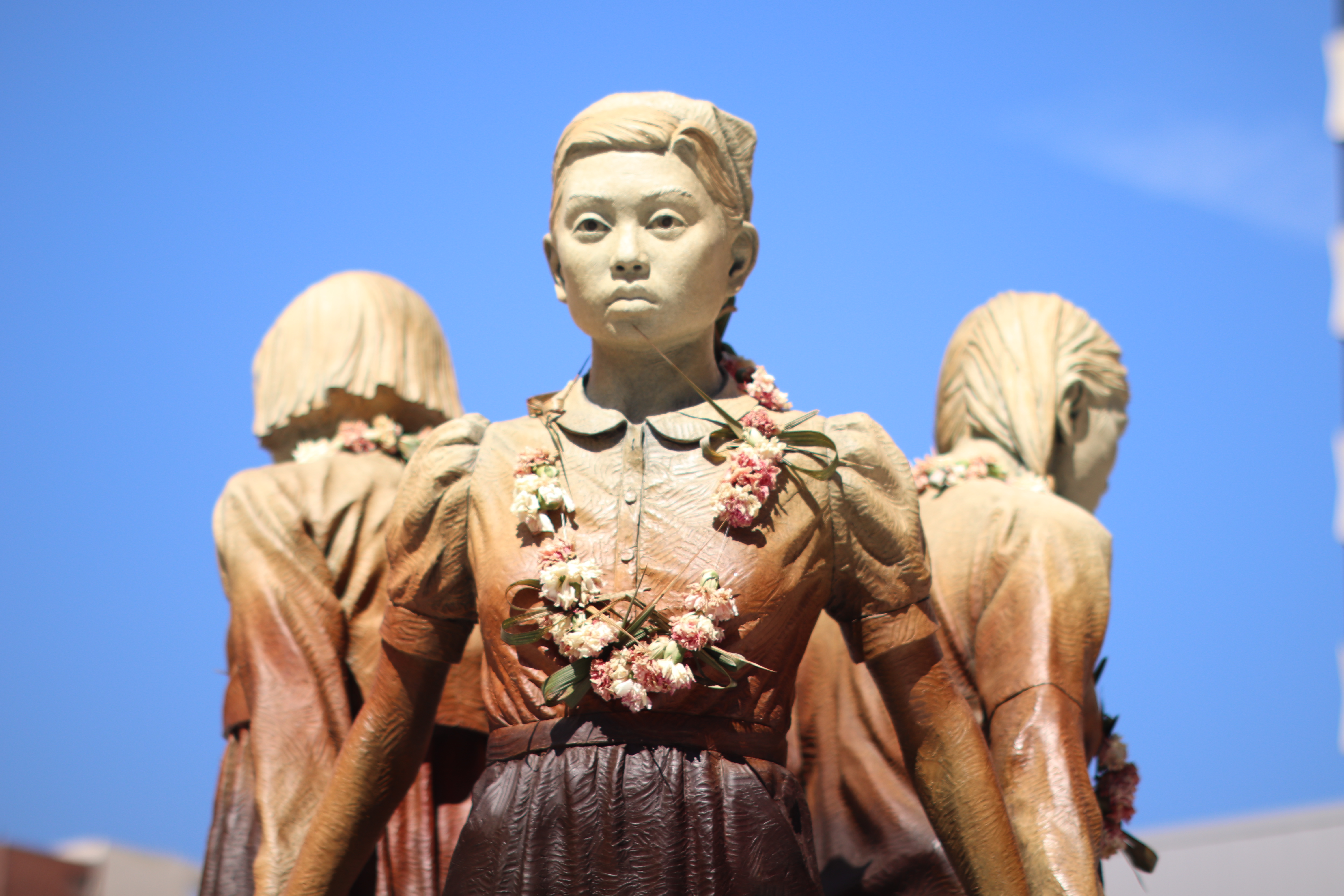
“Comfort Women” is a euphemistic phrase used to describe around 200,000 women and girls (actual numbers vary according to each source, although some claim the numbers might have been as high as 400,000) who were coerced into sexual slavery by the Japanese Imperial Army in occupied territories before and during WWII (1931-1945). This was the largest institutionalized system of sexual slavery in the twentieth century. Girls as young as 10 years old and women from at least 13 countries were taken, including: Korea, China, the Philippines, Taiwan, Indonesia, Vietnam, Thailand, Burma, Malaysia, Okinawa, East Timor, Guam, and Australia.
The Japanese Imperial Army first started with early recruitment during the Russo and Sino Japanese Wars (1894 - 1895 and 1904 - 1905), but it wasn’t until the Nanjing Massacre in 1937, where the “comfort woman system” became fully operational, as testimonies and reports told how women and girls were raped and systemically prostituted in Japanese “comfort stations.” The justification for this system was apparently to prevent soldiers from gang-raping women in occupied Manchuria (Fukushima, 2010, p. 761). Soon, the military enacted forced "recruitment" and kidnappings across Japanese colonies. Girls and women were either directly taken by the Japanese, or by local governments and police departments who were ordered to provide women for them. They were also tricked with false promises of jobs (working in factories or hospitals) and instead, “found themselves trapped in a system of normalized sexual violence, or, rather, institutionalized rape” (p. 759).
These so-called “Comfort Women” were mostly teenagers, between the ages of 13-16. They were trafficked to comfort stations located all over occupied Japanese territory, oftentimes far from their homes, and trafficked from location to location. They were raped by some accounts up to 50 times daily, and when they resisted, the girls and women were starved, beaten, tortured, killed, and many ended up committing suicide. If they became pregnant, abortions were forced and some became infertile because of the daily systematic abuse and torture or due to STDs. It’s estimated that only 10 - 35% survived, particularly after Japan’s defeat in 1945 when many of the girls and women were killed by soldiers in an attempt to destroy evidence of the “comfort women” system (Fukushima, 2010, p. 761; Qiu, et al, 2013, p. 71 and p.74). The few who escaped or survived were abandoned in foreign countries, far from their homes. Many did not return home due to shame or for fear of being rejected by their families. They lived for decades in secrecy and suffered alone in silence, until 1991 when survivors began to share their testimonies publicly and confronted the Japanese government, demanding reparations and a formal apology. Three decades later, those demands have not been met.
Breaking the Silence and Justice for “Comfort Women” Movement
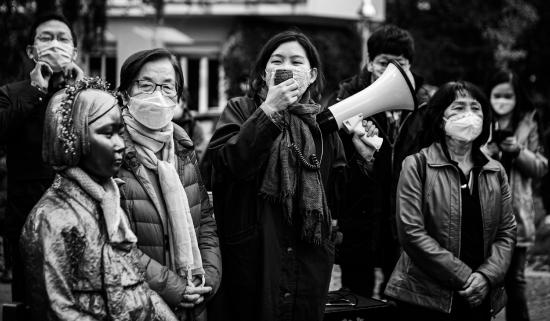
Decades of silence and denial followed the war, but during the 1980s and 1990s, Japanese, South Korean, and Chinese activists, journalists, and feminists started to bring attention to this history. In 1991, former "comfort woman" Kim Hak-soon broke the silence and was the first to publicly testify to her experience, then others followed suit. The Japanese government denied any military and state involvement in creating a sex slavery system. Kim testified,
For fifty years, I have had a heavy, painful feeling, but kept thinking in my heart about telling my experience some day. . . As I try to speak now, my heart pounds against my chest, because what happened in the past was something extremely unconscionable . . . Why does [the Japanese government] tell such a lie [to deny its knowledge of comfort women system]? Actually, I was made into a comfort woman, and I’m here alive (Nozaki 2005).
In 1992, Japanese historian Yoshiaki Yoshimi discovered direct evidence of the Japanese military’s role in overseeing “comfort stations” despite the government's absolute silence about wartime atrocities committed during Japanese occupation in various parts of Asia. The continued denial is a struggle this movement faces, but the justice for “Comfort Women” movement remains “one of the most visible global initiatives to break the silence surrounding wartime atrocities and sexual violence” (Fukushima, 2010, p. 760). The movement to reveal the “dirty” secret of war and the use of rape as a weapon is an international human rights issue. The call for redress and reconciliation exposed the systemic role of the military in organized rape and torture, and Asian Americans in this movement have made important connections to the hypersexualization of Asian women and men, impacts of colonialism, western expansion being linked to violence, racism, and sexism, redress for war crimes, and the effects of sexual violence against women (pp. 759-760).
The movement uplifted testimonies of the brave “grandmothers,” highlighting the important role of testimonies by everyday persons in the field of Ethnic Studies and understanding the history of marginalized racial groups. Professor of Ethnic Studies, University of Utah, Annie Fukushima, wrote that,
Testimonials by surviving comfort women have shifted the paradigm of what counts as truth in Asian American history because the movement is defined by the voices of the comfort women, who suggest that there is a need to tell stories from the "ground up" and to hear the words of those who directly experience struggle. Testimonies convey that there are no words that can easily describe what the women went through. Such testimonies have proved valuable to the work of historians. Testimonies also proved critical for conveying to the Asian American movement what the comfort women experienced (2010, p. 760).
Surviving "Comfort Women" and activists have demanded a formal apology from the Japanese government, and sued for compensation. Some statements and apologies have been given by individual members of the Japanese government, such as when Prime Minister Miyazawa Kiichi officially apologized to South Korea (Nozaki 2005). But, there’s yet to be an official apology directed toward all the women of various nationalities, nor major policy changing statements. There's been minimal education about "comfort women" in school textbooks in Japan. Private funds were set in 1994 to compensate survivors, but many "comfort women" activists rejected it, citing it wasn't official since money came from private donations. More recently, there have been efforts by the conservative Japanese government and revisionist organizations to interrupt memorialization efforts in the U.S., largely denying the government's involvement or claiming that "Comfort Women" were highly paid prostitutes. As of 2022, the Japanese government continues to publicly deny any involvement, including one of their most boisterous deniers, former Prime Minister of Japan, Shinzo Abe (who was assassinated on July 8, 2022).
The 2015 “Agreement” between Japan and South Korea
The so-called 2015 “Agreement” between Japan and South Korea was only an oral “agreement,” never written, and has been rejected by “Comfort Women” survivors and their supporters. The discussed fund to support “Comfort Women” was conditional, Japan demanding that South Korea stop criticizing them and remove the "comfort women" memorial in front of the Japanese Embassy in Seoul, and consider the matter a "final and irreversible resolution." This “agreement” has also faced criticism for excluding surviving “Comfort Women,” including those from 12 other nations, for negating coercion and legal responsibility by the Japanese government, and because this so-called compensation would not be paid directly to survivors.
Surviving “comfort women” filed a lawsuit against the Japanese government and in January 2021, they won the case, but the Japanese government ignored the ruling. In another verdict in April of that same year, the court granted sovereign immunity to Japan and the “comfort women” victim’s lawsuit was ended. Regardless, both trials acknowledged the survivors’ claims about the Japanese military’s role in coerced sex slavery (Hosaka, 2021).
Fighting for Justice from the U.S.
Activists in the United States also fought for justice for our "grandmothers," pressuring political representatives to take action. In 2007, Representative Mike Honda sponsored House Resolution 121 which expressed that the government of Japan "should formally acknowledge, apologize, and accept historical responsibility in a clear and unequivocal manner for its Imperial Armed Forces' coercion of young women into sexual slavery."
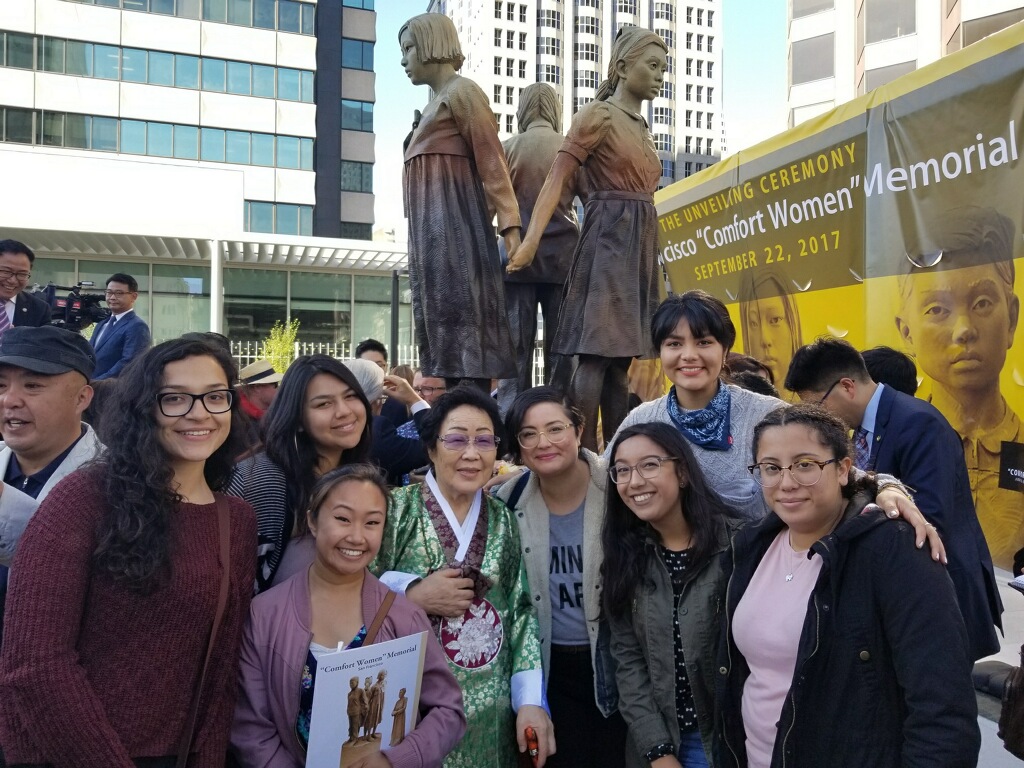
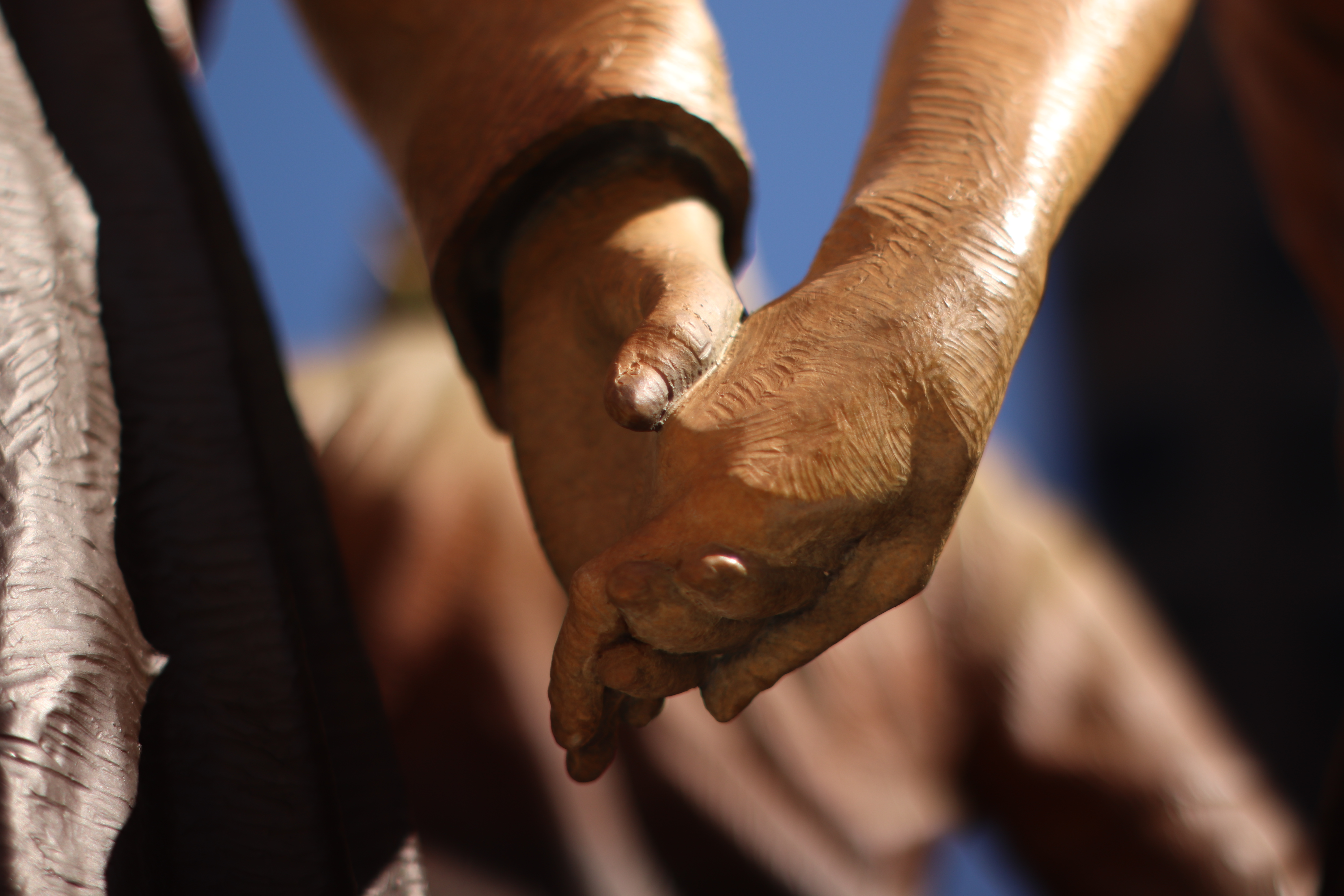
In 2015, San Francisco Board of Supervisors unanimously voted to approve a “Comfort Women” memorial to be built, becoming the first major city in the United States to have such a memorial. In addition, four more “Comfort Women” memorials exist in the U.S.: Glendale, CA, Virginia, Michigan, and New Jersey. In 2016, the California Board of Education approved the inclusion of "comfort women" in 10th grade world history curriculum. Both efforts have been supported by various human rights, feminist, and Asian American organizations, such as the "Comfort Women" Justice Coalition (CWJC), self-described as “a grassroots, multi-ethnic and multi-national group of individuals and organizations” ("Comfort Women" Justice Coalition). Author, Kay Fischer, is a member of Eclipse Rising, one of the partner organizations that participated in this coalition and in the campaign to bring about the memorial.
Prompted by the Abe administration’s “massive global PR campaign to ‘correct’ the world’s understanding of Japan’s history….‘Comfort Women’ denialism has come stateside, hitting home for Asians and Asian Americans across the diaspora” (Kim Lee, 2016). Revisionists have claimed, without evidence, that memorials prompt hate crimes towards the Japanese community, and often completely deny that such a system ever existed, asserting that “Comfort Women” were “highly paid prostitutes,” accusing these women to be liars, or disputing the number of women and children affected by this sex slavery system. American professor of Japanese Legal Studies, Harvard, Mark Ramseyer repeated such assertions in 2021, stating that Korean “comfort women” “chose prostitution.” Opponents went as far as attempting to sue the city of Glendale, CA to demand the removal of their memorial, but the lawsuit was dismissed in 2016 (Constante, 2017). Ninth Circuit Court of Appeals Judge Kim McLane Wardlaw claimed that Glendale erected a memorial that takes a stand against human rights violations which is well within the rights and responsibilities of local governments.
In 2018, the mayor of Osaka, Japan, Hirofumi Yoshimura, severed sister-city ties with San Francisco, attempting to force the mayor, London Breed, to take down the memorial, Column of Strength (Ingber, 2018). The San Francisco-Osaka Sister City Association responded that the sister-city relationship is not between the two city governments, but instead a partnership between the two cities’ civic organizations, nonprofits, and businesses. On the one-year anniversary of the memorial’s unveiling in San Francisco, September 22, 2018, delegates from two Japanese organizations, the Kansai Network to Resolve the Comfort Women Issue and the Forum from the Improvement of Osaka, visited and participated in the ceremony. Pang Chung Ja of the Kansai Network, stated, "Even if the mayor of Osaka proceeds with the termination, I feel that our relationship with the people of San Francisco has only deepened these past few years and only continues to grow stronger….Let us work together to solve this issue" (Hirai, 2018). Hisaye Ogawa with the Osaka delegation mentioned that they came to seek an apology from their own Japanese government.
Miho Kim Lee of Eclipse Rising and the CWJC, who was instrumental in coordinating visits by the two delegations from Japan, wrote that teaching “Comfort Women” history and erecting memorials serve the long-term purpose of remembrance, but is also in and of itself a “subversive act of resistance.” She continued, “...let us fight for the right to remember our beautiful and enduring legacy of suffering, courage, survival and joy, which serves as a reservoir of strength to inform our cultural identities and visions for the world” (Kim Lee, 2016).

No comments:
Post a Comment