Reflection Summary: Transformational Liberation through Love (8.6)
Section 8.6 helped me see love as a serious political and social idea. This chapter explains that love is not only a private feeling. Love can be a practice. Love can be a form of survival. Love can also be a path toward liberation for people who live under oppression (Fischer). When I read this chapter, I felt that it connected the pain of injustice with a way forward. It did not ignore violence or trauma. Instead, it showed how people heal, resist, and rebuild through self-love and community love.
The chapter begins with bell hooks. The author describes hooks as an activist, feminist, and prolific writer. hooks wrote All About Love: New Visions in 2001. hooks says she learned how much love mattered because she experienced its absence (hooks ix). This line is simple, but it is powerful. It shows that love becomes visible when it is missing. hooks also critiques society’s obsession with being desired and “finding” love, while avoiding honest conversations about love (hooks xi). I relate to this idea because many people talk about romance, but they do not talk about the daily work of love. The chapter suggests that hooks wrote her book as a call to return to love and “let our hearts speak” (hooks xi). In my understanding, this means love requires honesty, not just fantasy.
The chapter then connects hooks to Dr. Maythee Rojas. Rojas argues that love provides a way forward for women of color (Rojas 135). The chapter emphasizes that self-love and self-care are rooted in radical women of color writings. It explains that for many women of color, love is not a luxury. Love is survival in a world shaped by white supremacy, imperialism, capitalism, and heteropatriarchy (Fischer). This sentence helped me connect love with intersectionality. Intersectionality is not only about analyzing oppression. It is also about recognizing how people carry multiple identities and survive in complex ways. The chapter argues that if we accept lovelessness as normal, we move toward destruction. But if we choose love, we create space to thrive and to keep fighting (Fischer). This framing makes love feel like an action and a responsibility.
The chapter also acknowledges the emotional weight of studying injustice. It says learning about violence can be disheartening and overwhelming. But an intersectional lens can also help us find resilience in oppressed communities (Fischer). This is important. Sometimes academic learning focuses only on suffering. This chapter insists we also look for strength. It says love can connect stories of struggle and survival. It also says Ethnic Studies helps us unravel inherited trauma from settler colonialism, slavery, wars, and genocide (Fischer). This matters to me because healing is not only individual. Healing is historical and collective.
Next, the chapter describes how community love forms when marginalized people find others who understand them. The chapter gives an example through literature. It discusses This Bridge Called My Back: Writings by Radical Women of Color, edited by Gloria Anzaldúa and Cherríe Moraga, first published in 1981 (Fischer). This anthology centered the intersections of race, gender, class, and sexuality and transformed feminism in the United States (Fischer). I learned that writing can create community, especially for people who feel isolated. Rojas explains that the anthology held pain and anger but also joy, and it carried a promise of building bridges (Rojas 29). Moraga describes the “pain and shock of difference” and also the “joy of commonness” when women meet each other despite “incredible odds” (qtd. in Rojas 29). This quote helped me understand that solidarity is not automatic. It takes work. People are different. People can misunderstand each other. But love can help people build bridges instead of building walls.
The chapter then focuses on emotional repair. Rojas argues that social justice work is not only about dismantling structures. It is also about repairing emotional damage from racism, sexism, homophobia, transphobia, and poverty (Rojas 137). She says not loving others creates divisions and internal conflict, and not loving ourselves leads toward annihilation (Rojas 137). This part made me reflect on internalized oppression. When a society teaches people they are unworthy, people may begin to believe it. That belief can harm mental health. It can also harm community unity. So love becomes a tool to fight internalized shame and to protect community relationships.
The chapter returns to bell hooks and explains self-love as a foundation. hooks writes that when we can see ourselves truthfully and accept ourselves, we build the foundation for self-love (hooks 53). But hooks also notes that self-love can be confusing when people are socialized to feel “unlovable” (hooks 53). She warns that it is easy to get stuck in grief and blame. Instead, she encourages the next stage: actively introducing life-affirming thought patterns and behaviors (hooks 55). She also emphasizes living consciously and taking responsibility (hooks 55). This does not mean denying oppression. It means choosing how to respond to injustice and reclaiming agency (hooks 57). I liked this point because it balances truth and empowerment. It does not blame oppressed people for oppression. It helps people regain control of their responses and well-being.
The chapter then introduces Sonya Renee Taylor and the concept of radical self-love. Taylor wrote The Body Is Not an Apology in 2018. She argues that oppression like racism, sexism, ableism, homophobia, transphobia, ageism, and fatphobia shows up in our struggle to make peace with our bodies (Taylor 4). She defines radical self-love as deeper than self-esteem and more expansive than self-acceptance (Taylor 6). She explains that “radical” means at the root of our relationship with ourselves (Taylor 6). Taylor’s point is that society teaches people to hate their bodies through media and harmful messages. This is why something radical is needed (Taylor 7). Taylor also connects self-love to intersectionality. She says radical self-love demands seeing ourselves and others in the fullness of complexities and intersections, and creating space for those intersections (Taylor 9). This is a strong connection. Intersectionality is not only theory. It is also a daily practice of respecting difference.
Taylor also writes about apology and shame. She explains how many people are trained to apologize for existing in bodies that society labels as “wrong” (Taylor 11–13). She gives painful examples, including Emmett Till and how apology can be “exacted by death sentence” (Taylor 13). She also describes how survivors of sexual assault are pressured to apologize. Disabled people are pressured to apologize for needing access. Trans people are pressured to apologize for making others uncomfortable (Taylor 13). Taylor asks why people apologize for the space they inhabit and imagines a world where everyone can live without apology (Taylor 14). This part helped me reflect on how shame is political. Shame is not only personal. Shame is created by systems.
Taylor shares a story about posting a photo of herself. She feared judgment and heard “voices of apology” in her mind (Taylor 15). But she posted the photo and invited others to share photos unashamed and unapologetic (Taylor 16). Many people responded. A community formed. Taylor says being unapologetic created an opening for radical self-love (Taylor 17). This example shows how individual actions can create collective healing.
Taylor also critiques the logic of “choice.” She argues that people use “choice” to justify judging others, like claiming people “choose” to be gay, and then blaming them for being different (Taylor 18). She asks, “Why do I need people to be the way I believe they should be?” (Taylor 18). This question is important because it challenges control. It encourages people to examine their own discomfort instead of policing others.
Taylor introduces the “Three Peaces”: make peace with not understanding, make peace with difference, and make peace with your body (Taylor 18–19). She says understanding should not be a requirement for love (Taylor 19). She also rejects the idea “we’re all the same” because it can erase real differences (Taylor 21). She connects this to health rhetoric that labels disabled bodies as defective instead of different (Taylor 22). She calls for a culture that celebrates difference, not only within “normal” boundaries (Taylor 22). This part helped me see love as acceptance without conditions.
Finally, the chapter explains love as a mobilizing force in decolonization. Rojas discusses Chela Sandoval’s idea that “falling in love” can guide revolutionary movement toward decolonized being (qtd. in Rojas 140). Then the chapter describes the Hupa Flower Dance ceremony (Ch’ilwa:l) and how its revitalization is a decolonizing praxis (Risling Baldy 126). Dr. Cutcha Risling Baldy writes about the ceremony as a public celebration of a young woman’s first menstruation and a foundation for survivance, women’s respect, and gender equality in Hupa feminism (Risling Baldy 126–27). The story of Kayla choosing to do the first public ceremony after many generations shows love for self, culture, and community (Risling Baldy 131). The chapter also includes Lois Risling’s statement that celebrating women changes how men view women, not as objects but as important to society (Risling Baldy 143–44). This part helped me see culture as healing. It shows how love can be practiced through ceremony, community, and respect.
Overall, this chapter taught me that transformational liberation requires love. Love is not weak. Love is resistance. Love is self-acceptance, community building, emotional repair, and decolonizing practice. Love helps people survive and helps people imagine a future beyond oppression (Fischer). This is why love becomes a way forward.
Works Cited
Fischer, Kay. “8.6: Transformational Liberation through Love.” Introduction to Ethnic Studies, ASCCC Open Educational Resources Initiative (OERI), Social Sci LibreTexts, CC BY-NC 4.0, n.d. Accessed 18 Feb. 2026.
hooks, bell. All About Love: New Visions. William Morrow, 2001.
Risling Baldy, Cutcha. We Are Dancing for You: Native Feminisms and the Revitalization of Women’s Coming-of-Age Ceremonies. University of Washington Press, 2018.
Rojas, Maythee. Women of Color and Feminism. Seal Press, 2009.
Taylor, Sonya Renee. The Body Is Not an Apology: The Power of Radical Self-Love. Berrett-Koehler, 2018.



Love as a Way Forward
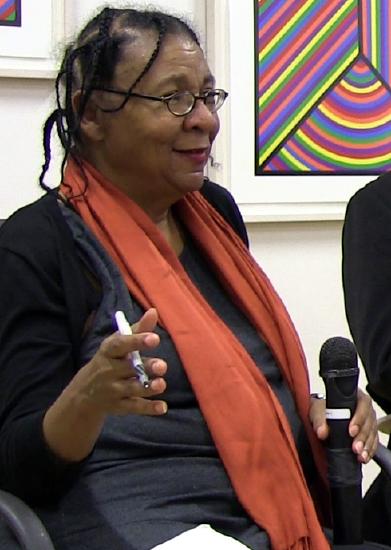
When I think of love as a transformational concept, I go back to the work of activist, feminist, and prolific writer, bell hooks (Figure
In her book Women of Color and Feminism (2009), Dr. Maythee Rojas also projected the importance of love, explaining, “love is what provides a way forward for women of color” (p. 135). In fact, the concept of self-love and self-care is rooted in writings by radical women of color, many finding that self-love is a matter of survival in a toxic white supremacist, imperialist, capitalist, heteropatriachy that seems to reserve the most hateful acts of violence and abuse towards women of color, particularly poor women of color, and Queer and Trans people of color. If we accept this lovelessness, we’ll only continue toward demise; it’s up to each of us to love ourselves and each other in order to thrive and continue fighting for a world that embraces love and embraces our differences.
At times it can be disheartening to learn about violent injustices and overwhelming to comprehend how oppression may have impacted our lives. However, applying an intersectional lens can also help us uncover the power of resilience amongst oppressed communities. This can be especially true in the ways that we find love in ourselves, for our ancestors, our culture, and our communities. This starts by breaking through the damaging messages and practices, stemming from the legacies of settler-colonialism, imperialism, wars, slavery, and genocide. Ethnic Studies allows us to see that we absolutely can unravel the traumas that we inherit. And an intersectional framing can help us to see and value the ways that love is often the connecting theme across stories of struggle and survival.
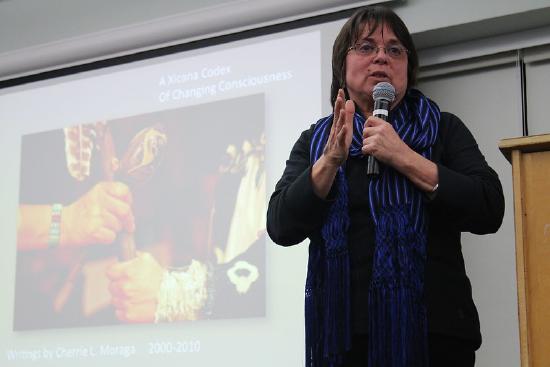
When human beings are marginalized, it is tremendously validating and empowering to find others who understand our experiences. This lends the possibility of finding love in a community. An example of finding community and love through written work is the groundbreaking publication of the first edition of This Bridge Called My Back: Writings by Radical Women of Color, edited by Gloria Anzaldúa and Cherríe Moraga (Figure
To come to see each other as sisters. This is not a given. I keep wanting to repeat over and over again, the pain and shock of difference, the joy of commonness, the exhilaration of meeting through incredible odds against it (as cited in Rojas, 2009, p. 29).
Rojas emphasizes how Moraga’s excitement cannot be overstated, as many of the contributors, including Moraga and Anzaldúa, were lesbians of color, often isolated and marginalized within their families and also among women of color feminist spaces.
Dismantling the status quo can be daunting, and Rojas argues that while there are concrete structures to take down in order to advance social justice and equality, “there is also an emotional repairing that must take place” tied to the damage that generations of racism, sexism, homophobia, transphobia, and poverty can inflict on our self-esteem and sense of self-worth. She writes: “Not loving others is one of the most effective ways to ensure divisions and internal conflict. Not loving ourselves warrants our annihilation” (2009, p. 137).
bell hooks wrote that “when we can see ourselves as we truly are and accept ourselves, we build the necessary foundation for self-love” (2001, p. 53), but that this assertion can be confusing, especially if we were socialized to see ourselves as “unlovable.” She continues that while it may be helpful to reflect on our childhood to understand how one’s sense of identity was shaped, we can get stuck holding onto grief and pain and place blame on others. hooks promotes the importance of the next stage of self-love, which includes “actively introducing into our lives constructive life-affirming thought patterns and behavior” (p. 55). This includes thinking critically about ourselves and our society: to live consciously. This means acceptance of ourselves and taking responsibility in all areas of our lives. This does not mean denying the reality of oppressive systems like racism, classism, homophobia, and sexism, nor preventing discrimination from happening. Instead, accepting ourselves and taking responsibility means “we can choose how we respond to acts of injustice” (p. 57). hooks emphasizes how taking responsibility can lead to reclaiming agency over our lives and help center our well-being.
Radical Self-Love
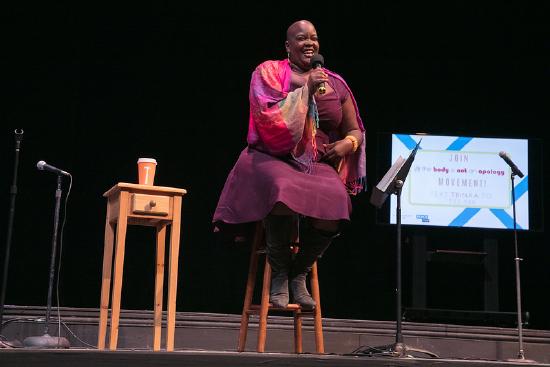
Sonya Renee Taylor (Figure
On apologizing for our bodies, Taylor shared that living in a female, Black, aging, fat body with mental illness, she was “to awaken daily to a planet that expects a certain set of apologies to already live on our tongues…traumas and resiliency of our ancestors are passed on to us molecularly. Being sorry is literally a lesson in our DNA” (2018, p. 11). For Black boys like Emmett Till, that apology could be “exacted by death sentence,” who was expected to be sorry for allegedly whistling at a white woman, his 14-year old body kidnapped, tortured, beaten, mutilated, then shot and dumped in the Tallahatchie River by a group of adult white men. Taylor points out how women are expected to apologize about the length of their skirt or how many drinks they had after a sexual assault; that disabled people were expected to apologize for their need to access; and that if one’s gender identity was different than the sex assigned at birth, and it confused strangers, an apology was expected. Our society has conditioned us be apologetic for not only having the “wrong body” but also for supposedly stirring discomfort in others, Taylor writing, “...it was in these moments that we found our heads bowed in shame, certain that our too fat, too dark, too muchness was the offense” (p. 13). She asks,
Why are we consistently apologizing for the space we inhabit? What if we all understood the inherent vastness of our humanity and therefore occupied the world without apology?....What if we made room for every body so that no one ever had to stand on someone else’s foot? How might we change our lives? How might we change the world? (p. 14).
In February of 2011, Taylor decided to post a picture of herself in a strapless corset: “I was being saucy, sexy, and silly, and I absolutely did not think a single soul besides myself would ever lay eyes on that photo” (2018, p. 15). For six months, she would revisit this photo in her cellphone, fearful of the judgment that could come if she posted it on social media. Taylor describes that “the voices of apology” would take over her brain, and she'd wonder:
Would people think I was vain? Would they fail to see the beautiful woman I saw in the image and instead simply remind me that I was too fat, too black, too queer, too woman, and no one was ever going to think that was beautiful (p. 15)?
But after being inspired by photos of plus-size model, Tara Lynn, Taylor posted her photo on Facebook with a caption that read: “In this picture, I am 230 lbs. In this picture, I have stretch mark….For this one camera flash, I am unashamed, unapologetic” (2018, p. 16). She encouraged others to share their photos, unashamed and unapologetic, and the next morning discovered over thirty photos that people posted, of varying ages, races, sizes, abilities, genders, sexual orientations. A Facebook group page titled “The Body is Not an Apology” was born. Taylor proclaims that “Being unapologetic created an opening for radical self-love” (p. 17) and when one “embraces the fullness of ourselves” (p. 17) we can love our whole selves.
Taylor (2018) critiques the perceived logic of “choice” which she argues leads to justifying judgment of bodies and difference. For example, to claim that people choose to be gay is a scapegoat for our biases and bigotries, because the logic believes if people choose to be different, then they should choose to be the way “I believe they should be.” Taylor instead proposes that we ask ourselves, “Why do I need people to be the way I believe they should be?” (p. 18) and that the argument about choice is actually a projection. She also offers what she calls the Three Peaces, the key tenets to “pry us out of the mire of body judgment and shame” (p. 19):
- Make peace with not understanding
- Make peace with difference
- Make peace with your body (pp. 18-19).
Understanding should not be a prerequisite to love, and Taylor (2018) encourages us to accept that we can’t have everything figured out. In fact, when we comprehend this notion, this can lead to empathy, writing, “Not knowing is an opportunity for exploration without judgements and demands” (p. 19). On the tenet of making peace with difference, Taylor rejects the notion that “we’re all the same,” a type of mask that veils our own ignorance about someone else’s experience, and instead of admitting it and accepting that we can’t understand everything, we’re prompted to minimize it and instead “homogenize it by proclaiming we are all the same'' (p. 21). She applies this concept to the rhetoric of health, pointing out how hegemonic ideas of what’s considered a “healthy body” can reinforce the oppressive idea that people with illnesses and disabilities have “defective bodies rather than different bodies” (p. 22). She addresses the larger issue of our society projecting “greater value, resources, and opportunities” (p. 22) to so-called “normal” bodies, ideas warped by hegemony. Taylor calls for a shift from “occasionally celebrating difference (as long as it doesn’t fall too far outside the boundaries of our ideas of ‘normal’) to developing a difference-celebrating culture” (p. 22). On the third tenet, peace with your body, Taylor reminds us that if we believe our body should be some other body, it’s likely a “reflection of your struggles with the first two Peaces” (p. 23). She emphasizes that we didn’t come into this world hating our bodies, therefore what we’ve internalized about our bodies is learned. Not only is our internalized body shaming hurting ourselves, it hurts those around us as well. Taylor states that, “The bodies you share space with are afraid you are judging them with the same venom they have watched you use to judge yourself” (p. 24).
With these tenets, Taylor (2018) boldly reminds us that radical self-love is not impossible, nor a destination. She stresses how embracing your body is “awakening…who you have always been: the physical, spiritual, and energetic manifestation of radical self-love” (p. 58). Taylor describes this journey of dismantling body-shame practices as a map - and that radical self-love is drawing “a map back to ourselves” (p. 58).
The Hupa Coming-of-Age Dance as Decolonizing Praxis
An important aspect of transformational love is how love can be used as a mobilizing force, as noted by Rojas when discussing the work of Chicana/o Studies scholar, Chela Sandoval. In her work, Methodology of the Oppressed (2000), Sandoval finds that “falling in love” can be a type of “conduit” for the action needed to resist oppression. Sandoval writes, “It is love that can access and guide our theoretical and political ‘movida’ [movements] - revolutionary maneuvers toward decolonized being” (as cited in Rojas, 2009, p. 140).
Decolonization is a process of self-love, reclamation of our heritage, and a powerful act of counterhegemony. In We Are Dancing for You: Native Feminisms and The Revitalization of Women’s Coming–of-Age Ceremonies (2018), Native American Studies professor, Humboldt State, Dr. Cutcha Risling Baldy (Hupa, Karuk, Yurok), writes about the revitalization of the Hupa Ch’ilwa:l, or Flower Dance ceremony, a public celebration of a young woman’s first menstruation, as a decolonizing praxis. Risling Baldy describes how it was her niece, Kayla, who had the first public community Ch’ilwa:l in Hoopa Valley after its absence for many generations. She was 14 and among discussions of bringing back the ceremony, some in the community were enthusiastic and others were hesitant, but Kayla thought, “...if I could be strong and I could do it, then other people who need this dance could have it too, and that was sort of an easy decision to me” (p. 131). Kayla expressed a love for herself and her culture, and by stating that she would also do it so that other girls might have this too, she expressed a love for her community.
Risling Baldy (2018) explained that built into the Ch’ilwa:l, is “The epistemological foundation of survivance and decolonization” which “understand that every aspect of that landscape is embodied by the K’ixinay [immortal spirits], demonstrates respect and empowerment of women, insists gender equality and is grounded in Hupa feminism” (p. 126). There is an inherent sensibility of intersectional framing as decolonization is a form of feminism. Risling Baldy cites Jaimes Guerrero’s call for a formation of “Native Womanism” through traditional practices that center on “women’s respect and authority” (p. 127). Risling Baldy also references Native scholars who stress that decolonizing praxis and Indigenous epistemologies and cultures are a basis for healing. The Hupa ceremony of Ch’ilwa:l focuses on movement as a site for addressing trauma or “unresolved historical grief across generations” that’s been carried by Native peoples. She brings up how the effects of colonization have traumatized the physical and psychological and that cultural indigenous practices can “restore balance” and focus on dismantling sexism.
The revitalization of the Ch’ilwa:l has transformed some of the inherited traumas related to “gender violence of colonization.” Lois Risling, Risling Baldy’s mother, remarked that the dance has encouraged men to view women in “a different light.” She emphasized that,
When you dance over somebody and celebrate somebody you don’t think of them just as a piece of meat or just some kind of sexual object….this ceremony definitely shows that women are important to the society and play a very important part in it (2018, pp. 143-144).
Risling Baldy adds that Native American cultural practices are proven to effectively address self-esteem, poverty, and school performance for youth, citing the work of Teresa LaFromboise who found that family and community support, along with involvement in cultural practices can lead to “resilient adaptation.” Lois Risling also stated how the Flower Dance ceremony supports a young woman's development of self-worth. She said,
it tells you that you are not this piece of crap stuff that somebody can abuse and put down. You are being celebrated, as opposed to being demonized….If all of your life you’ve been told that you are worthless and that you’re only good as a sexual partner or somebody who is being abused or beat up…that you’re not worth anything…then this dance comes along and say, ‘I think enough about you that I’m going to for ten days or five days…sing over you every night….That’s very, very positive. That’s very important, that I think you’re worth that” (Risling Baldy, 2018, p. 145).
For further understanding of Risling Baldy's writing, checkout the section titled "Dr. Cutcha Risling Baldy" under Chapter 4, page 4.2: "Indigenous Ways of Knowing."

No comments:
Post a Comment