Reflection Summary: Intersectionality and Reproductive Justice (8.4)
Chapter 8.4 helped me understand reproductive justice in a deeper way. Before this reading, I mostly thought about abortion as a legal issue. I thought it was mainly about “pro-choice vs. pro-life.” This chapter explains why that framing is too narrow. It also explains why women of color created a different movement. That movement is called reproductive justice. It uses intersectionality. It connects race, gender, class, sexuality, and immigration status. It shows how these forces work together at the same time (Fischer).
The chapter begins with the 2022 Supreme Court decision that overturned Roe v. Wade. The reading explains that abortion access was already unequal even before that ruling. Poor women and women of color often faced barriers to safe care. So legality alone did not create real access. That is why reproductive justice is not only about abortion laws. It is about the conditions that shape people’s choices and safety (Fischer). I think this is a powerful point. A “right” on paper is not always a right in real life.
The chapter uses Loretta Ross and Rickie Solinger to define reproductive justice. It lists three main values. The first is the right not to have a child. The second is the right to have a child. The third is the right to parent children in safe and healthy environments (Ross and Solinger 65). This definition feels broader and more human. It is not only about stopping pregnancy. It is also about dignity, safety, and family life. The chapter also adds sexual autonomy and gender freedom as part of reproductive justice (Ross and Solinger 65). That shows that this movement includes LGBTQ+ people and trans people too. It includes all “reproducing persons,” not only cisgender women (Fischer).
The chapter then explains that reproductive injustices have a long history in the United States. It gives many examples. It includes rape, forced sterilization, lack of contraception, separation of children from parents, and laws that blocked families from forming (Ross and Solinger 13–14). This section helped me realize that reproductive control has been used as a tool of power. It was not random. It was connected to building a white nation. It was connected to wealth. It was connected to land. It was connected to labor (Fischer).
One of the strongest parts of the chapter is the history of enslaved Black women. The reading explains that colonial elites wanted population growth for their own power. They wanted to control African American reproduction and remove Native peoples. This was population control in a white supremacist system (Ross and Solinger 18). The chapter explains the 1662 Virginia law that made children’s status follow the mother. This guaranteed that children of enslaved mothers would also be enslaved. That created a system that reproduced slavery through women’s bodies (Ross and Solinger 18–19). I felt sick reading this, but it made the meaning of “bodily autonomy” very real. It also showed that the state shaped reproduction through law.
The chapter also explains how rape and abuse were connected to slavery. It says enslaved women were stripped of sexual, relational, and maternal rights. Mixed-race children were labeled “illegitimate” and pushed into forced labor. This helped legalize the domination of enslaved women (Ross and Solinger 19). The chapter describes the physical suffering too. Women lost pregnancies because of overwork. Babies died from poor conditions. Women had little food and little rest (Ross and Solinger 20). At the same time, the chapter also shows resistance. Enslaved women shared fertility knowledge. They used herbal contraceptives. Midwives helped in secret abortions. Some women even killed newborns to prevent a child from being born into slavery (Ross and Solinger 20–21). This is painful, but it is also a form of agency. It shows that even under extreme violence, women still made choices to claim personhood (Ross and Solinger 20–21).
The chapter then shifts to Native American communities. The government wanted Native population decline. The chapter calls genocide the “ultimate population control policy” (Ross and Solinger 22). It describes forced removals and marches. It describes women being forced to keep marching while in labor. Many mothers and babies died. Indigenous rituals and healthcare practices were blocked (Ross and Solinger 22). This helped me connect reproductive injustice to colonization. It is not only about clinics or hospitals. It is also about land theft and forced displacement.
The chapter also explains a contrast. White women’s fertility was protected in the 1800s. The reading says white women once had legal abortions in early U.S. history. But in the 1820s, male physicians took control of obstetrics and gynecology and pushed laws against abortion. By the end of the 1800s, abortion was outlawed in every state (Ross and Solinger 23–24). The Comstock Law of 1873 increased surveillance of contraceptives through the mail (Ross and Solinger 24). This shows how the state protected “white nationhood” by controlling white women’s reproduction differently than it controlled women of color (Fischer).
The chapter also discusses migration and family separation. After the Civil War, Black women migrated north to escape sexual violence and to protect their children. They gained better access to contraception in some northern cities (Ross and Solinger 27). Native families faced boarding schools. Children were taken to be “civilized.” Language and culture were suppressed. When parents resisted, food was withheld and police raided camps to seize children (Ross and Solinger 27–28). This part made me realize that parenting rights are part of reproductive justice. It is not only about pregnancy. It is also about the right to keep and raise your children.
The section on Asian exclusion also connects clearly to reproductive justice. The Chinese Exclusion Act of 1882 blocked Chinese women from immigrating. The chapter shows how Chinese women were only 3.6% of the Chinese population in 1880 and 12.6% in 1920. Anti-miscegenation laws also blocked family formation. This meant Chinese men could not easily create families in the U.S., and few babies gained birthright citizenship then (Ross and Solinger 29; Lee 90). This is reproductive control through immigration policy. It is also racial control.
The chapter then explains eugenics and forced sterilization. Eugenics claimed white superiority and blamed poverty and “social problems” on genetics (Ross and Solinger 30; Rojas 98). It targeted nonwhite people, poor people, and disabled people. The Immigration Act of 1924 used “scientific” arguments to protect white identity and exclude Asians and other groups (Ross and Solinger 31–32). The chapter shows how “science” can be used as a weapon. It can justify oppression. It can be made to sound neutral while producing harm.
The most shocking examples are the Relf sisters and Madrigal v. Quilligan. The Relf sisters were 12 and 14 years old. They were sterilized without real consent in Alabama through a government-funded program (Rojas 100–01). The case revealed that up to 150,000 people per year were sterilized using federal dollars (Rojas 100). Madrigal v. Quilligan exposed coercion of Chicanas in Los Angeles hospitals. Women signed English forms while in labor or under anesthesia. Some were lied to. Some were called a burden on taxpayers (Ruíz and Sánchez Korrol 416–19). Even though the women lost the case, it increased public awareness and led to guideline changes (Ruíz and Sánchez Korrol 419). These examples show how racism and classism shape medical power. They also show how “consent” can be manipulated.
The chapter also discusses Puerto Rican “operaciones.” Puerto Rico became a laboratory for U.S. contraceptive policies. By 1965, about 35% of Puerto Rican women had been sterilized (Gutierrez; Rojas 102). The chapter explains how stereotypes of “hyperfertility” supported this program. It was framed as economic improvement, but it harmed women’s autonomy (Fischer).
The chapter then explains coerced sterilization of Indigenous women through Indian Health Services. WARN estimated sterilization rates as high as 80% on some reservations, and research estimated around 42% between 1968 and 1982 (Ross and Solinger 50). Reports describe women being sterilized for unrelated treatments, like headaches or tonsillectomy visits (Smith 84). The GAO report found weak consent rules and poor accountability (Smith 84). This shows how federal institutions can violate human rights while claiming to provide healthcare.
Finally, the chapter connects history to the present. It discusses allegations in immigration detention centers in 2020. A nurse whistleblower described hysterectomies and medical abuse at Irwin County Detention Center (Project South). The chapter also mentions Scott Lloyd and efforts to block teen migrants from abortions, even in cases of rape (Manian). This part made me understand the instructor’s point from lecture. These issues are not only “in the past.” Reproductive control can still happen through institutions, detention, and unequal access.
Overall, this chapter taught me that reproductive justice is an intersectional issue. It is not only about “choice.” It is also about power and conditions. It is about who gets protected and who gets punished. It is about who gets to have children, who is forced not to, and who is allowed to parent safely. This reading also helped me see that women of color have led resistance for a long time. They organized against sterilization abuse. They fought for full healthcare. They demanded dignity. That is why reproductive justice is not only a concept. It is a movement for survival and freedom (Fischer).
Works Cited
Fischer, Kay. “8.4: Intersectionality and Reproductive Justice – Part I.” Introduction to Ethnic Studies, ASCCC Open Educational Resources Initiative (OERI), Social Sci LibreTexts, CC BY-NC 4.0, n.d. Accessed 18 Feb. 2026.
Gutierrez, Elena R. Referenced in Fischer, Kay. “8.4: Intersectionality and Reproductive Justice – Part I.” Introduction to Ethnic Studies, Social Sci LibreTexts, n.d.
Lee, Erika. Referenced in Ross, Loretta, and Rickie Solinger. Reproductive Justice: An Introduction. U of California P, 2017.
Manian, Maya. Referenced in Fischer, Kay. “8.4: Intersectionality and Reproductive Justice – Part I.” Introduction to Ethnic Studies, Social Sci LibreTexts, n.d.
Project South. “Whistleblower Complaint, Irwin County Detention Center.” Referenced in Fischer, Kay. “8.4: Intersectionality and Reproductive Justice – Part I.” Introduction to Ethnic Studies, Social Sci LibreTexts, n.d.
Rojas, Maythee. Referenced in Fischer, Kay. “8.4: Intersectionality and Reproductive Justice – Part I.” Introduction to Ethnic Studies, Social Sci LibreTexts, n.d.
Ross, Loretta, and Rickie Solinger. Reproductive Justice: An Introduction. U of California P, 2017.
Ruíz, Vicki L., and Virginia Sánchez Korrol. Referenced in Fischer, Kay. “8.4: Intersectionality and Reproductive Justice – Part I.” Introduction to Ethnic Studies, Social Sci LibreTexts, n.d.
Smith, Andrea. Referenced in Fischer, Kay. “8.4: Intersectionality and Reproductive Justice – Part I.” Introduction to Ethnic Studies, Social Sci LibreTexts, n.d.
If you paste 8.5 (Part II) too, I can write the next 1000-word MLA reflection in the same simple-sentence style and keep the themes connected.
8.4: Intersectionality and Reproductive Justice - Part I



History of Reproductive Justice
On June 24, 2022 the United States Supreme Court ruled 6 to 3 to overturn Roe v. Wade, ending fifty years of the right to access safe and legal abortion. However, for poor women and women of color (and all reproducing persons of any gender background), access to safe abortions has been a challenge even before this Supreme Court ruling. Furthermore, the issue of only legality, as abortion rights have been framed in white feminist movements, was too narrow for women of color who have historically faced and continue to meet the interlocking systems of power that attempt to take away agency over their own bodies.
Instead, the reproductive justice movement, led by women of color, applies an intersectional lens and expands the concerns beyond the limited framing of pro-choice v. pro-life. The intersectionality framing offers a broader understanding of restrictions placed on reproductive actions, examining the ways oppressions related to race, gender, class, and sexuality operate simultaneously. And therefore, “solutions require a holistic approach” (Ross and Solinger, 2017, p. 75). According to reproductive justice movement leader, Loretta Ross, who outlined the following in her book with Rickie Solinger, Reproductive Justice: An Introduction (2017), reproductive justice has three primary values:
- the right not to have a child
- the right to have a child
- and the right to parent children in safe and healthy environments
The authors write, "In addition, reproductive justice demands sexual autonomy and gender freedom for every human being. The problem is not defining reproductive justice but achieving it" (p. 65).
In the following two sections, we’ll examine the history of reproductive control and impacts of oppressive policies and practices that particularly target women of color. First, we should understand that options available to fertile people have always been limited by resources they have access to or don’t. Secondly, we’ll examine the specific ways that the goals of white nationhood and expansion have informed the reproductive and parenting experiences of communities of color. Reproductive injustices include rape, forced sterilization, inaccessibility to contraception, including abortion, separation of children from their parents, loss of pregnancies due to genocidal wars, forced removals and marches, antimiscegenation laws and exclusionary immigration policies that prevented the formation of a second generation of immigrants from Asia, and more. Such barriers placed in the past continue to impact many communities today (Ross and Solinger, 2017, pp. 13-14). Lastly, a reproductive justice framing also highlights instances of resistance and responses to such policies and practices led by women of color. This includes organizing to end racially based sterilization programs, access to full reproductive healthcare, and objecting welfare policies that punish poor women for “illegitimate” motherhood.
Reproductive Control and Resistance in Early U.S. History
Let’s begin in the colonial period. European settler-colonist elites from this era were primarily concerned with defining the members of this new nation: who did they want to be considered “American” and who did they want to exclude. Population growth became “...crucial for establishing, developing, and enlarging, and defending their land claims, their accumulation of wealth, and their political control of the settled territories” (Ross and Solinger, 2017, p. 18). Coinciding with this colonial project was the mass removal of Native American populations which interfered with European expansion, as well as increased numbers of enslaved labor by Africans, which was necessary to achieve a rapid accumulation of wealth. The strategy was to control the population growth of African Americans and expunge the population of Native communities, a dual sided approach with a goal of population control, a method of limiting the population numbers of a specific group. In the context of a white supremacist nation, population control was also “a crucial aspect of establishing ‘the legal meanings of racial difference’” (p.18).
A 1662 Virginia Colony law overturned an English common law that defined the status of children according to the father. This allowed the children of enslaved mothers to be automatically enslaved, thereby guaranteeing the continuation of a slavocracy. Enslaved women’s fertility now became “essential, exploitable, colonial resource” and it wasn’t important if her pregnancy resulted from rape or love, “engrossing the holdings of her owner” (Ross and Solinger, 2017, pp. 18-19). Another law passed in 1692 outlawing interracial unions, labeling all mixed race children as “illegitimate” and subjecting them into bonded labor. Such laws required the “complete subordination of enslaved women,” stripping away any sexual, relational, and maternal rights, practically legalizing the rape and abuse of enslaved women by white slave masters. These practices set in place the “...absence of reproductive dignity and safety,” making them “key to definitions and mechanisms of degradation, enslavement, and white supremacy” (p. 19).
Enslaved women would often lose their pregnancies, sometimes “right in the fields,” due to being overworked. They also suffered high infant mortality rates, miscarriages, and stillbirths. Even after giving birth to a newborn, mothers were often unable to produce sufficient breast milk due to inadequate diets, weaning their babies early, thereby resulting in more frequent pregnancies at shorter intervals (Ross and Solinger, 2017, p. 20). Still, women found ways share information on how to control fertility, including effective herbal contraceptives and midwives among them who operated abortions in secret. There were also instances of women killing their newborns in order to resist producing a new slave for the master and “consign a potential child to a life of enslavement” (p. 21). Although painful to read, Ross and Solinger (2017) remind us that, “Each of these acts continued a woman’s claim of full personhood - her linkage of her reproductive life to human freedom” (pp. 20-21).
While invested in the reproduction of enslaved women in order to produce more free laborers, the U.S. did not want that for Native American populations, seeing it in their best interest to terminate the growth of such peoples. The government’s objective was genocidal, which Ross and Solinger (2017) note was “the ultimate population control policy” (p. 22). Christian missionaries also played a significant role, trying to "correct" mothers with European birthing and child-rearing practices. Missionaries directed authority away from women as many tribes were egalitarian or matrilineal and, for example, among the Cherokee, women held political and economic authority (p. 21). The mass removals of Indigenous communities from their homes further west also resulted in the abusive conditions that threatened the wellbeing of pregnant women. Forced to march for days in the cold, with hardly any food or appropriate clothing, many women and their babies died. They were also prevented from practicing any Indigenous rituals associated with health; in fact, one missionary reported that the “‘Troops frequently forced women in labor to continue [marching] until they collapsed and delivered’ surrounded by soldiers” (p. 22).
In contrast, by the 19th century, laws against contraception and abortions reflected ideologies around the importance of “the white mother’s role in making the white nation and the government’s interest in protecting her fertility.” The white mother was a symbol of white nationhood, “...the nation’s most precious resource” (Ross and Solinger, 2017, p. 23). Before the American Revolution and for the first half of the 19th century, white women actually had access to legal abortions. But beginning in the 1820s, physicians began controlling the “lucrative domains of gynecology and obstetrics” and successfully lobbied to end access to abortion services. By the end of the 19th century, all states had outlawed abortion (p. 24). The federal Comstock Law of 1873 even allowed officials to surveil the mail, checking for contraceptives, putting control of fertility strictly into the hands of white male doctors.
After the Civil War, Black people began migrating out of the South during the first wave of the Great Migration (1910 - 1930). For Black women, it meant “moving away from sexually predatory white men who rarely faced legal sanctions when they attacked women of color” (Ross and Solinger, 2017, p. 27). Migration also translated as an act of protecting their children from daily terrorization by white supremacy, even as they faced a different type of racism and discrimination in these new areas. Still, in urban centers of the north, Black women had improved access to contraception and abortion services.
In the meantime, Native American women were battling coercion from the U.S. government to send their children to boarding schools, where Native children were supposedly raised to become “civilized.” In reality, these schools inflicted cruel measures to suppress tribal languages and cultural practices, a hegemonic project forcing children to assimilate and internalize white-centered American culture (Ross and Solinger, 2017, p. 27). When parents resisted having their children taken away, the government withheld food rations and called the police. An agent to the Mescalero Apache described how police would raid tribal camps to seize children. He witnessed parents running with their children into the mountains and the police having to chase and capture the children “like so many wild rabbits.” Women lamented out loud, and their children were “almost out their wits with fright” (p. 28).
As Indigenous families faced cruel genocidal practices by the U.S. government, population control policies continued to be carried out in order “to distinguish between the value of women’s reproductive bodies by race, class, and ethnicity” (Ross and Solinger, 2017, p. 28). Immigrants from Europe and Asia continued to meet the labor requirements of an industrialized nation, but immigration and welfare officials instituted policies that prevented the growth of such communities. For Asian immigrants, this meant exclusion laws, the first major one being the Chinese Exclusion Act of 1882, the first major immigration law enacted on large-scale exclusion based on race and class (Lee 2015, p. 90). As a result, Chinese laborers and wives of Chinese laborers were prevented from immigrating to the U.S., dramatically impacting the gender balance of this community. Women only made up 3.6% of the Chinese population in 1880 and 12.6% in 1920. Such gendered restrictions and antimiscegenation laws (preventing marriage between Chinese men and white women) practically guaranteed that Chinese men could not procreate in the U.S. As a result, hardly any Chinese babies were granted birthright citizenship during this era (p. 29).
Eugenicists and Forced Mass Sterilization
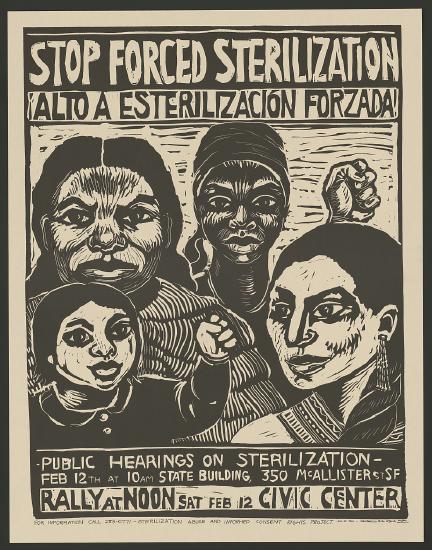
By the 20th century, Jim Crow was full blown in the South where neighborhoods, schools, swimming pools, and employment were all racially segregated. Antimiscegenation laws were used to separate the races, “making interracial sex and procreation a crime in many states” (Ross and Solinger, 2017, p. 30). Eugenics began to be popular, reinstating much bolder claims of white racial superiority and that it was possible to reproduce “the ‘best examples’ of humanity and eradicate ‘negative expressions' of human life” (p. 30). Genetic inferiority was blamed for larger social issues including criminality, poverty, prostitution, and mental illness, and eugenicists eagerly believed that removing supposedly inferior genes would “foster a superior human race free of these social ills” (Rojas, 2009, p. 98). Groups considered undesirable were nonwhites, the poor, and anybody with psychological, physical, and cognitive disabilities. Politicians began to create laws that criminalized interracial relationships and encouraged the sterilization of “socially inadequate persons,” thereby defining “racial difference and racial hierarchy as primary goals of the government” (Ross and Solinger, 2017, pp. 30-31).
The Immigration Act of 1924 or the National Origins Act put nationality caps on immigration meant to “protect the white identity of the United States” (Ross and Solinger, 2017, p. 31). The law included a supposed “scientific” study of the origins of the populations to use as a guide in determining who was allowable or not, completely excluding Asians and their descendants, descendants of “slave immigrants” and “American aborigines”; such restrictions continue to impact the racial and ethnic origins of populations born in the U.S. (p. 32).
Eugenicists also enacted policies that promoted contraception and sterilization to suppress the fertility of key groups. For example, birth control clinics aimed at poor African Americans were developed by public health officials who believed it was a service to “the public good” to decrease Black fertility. Sterilization became an active public health measure during the Depression, especially after the 1927 Supreme Court case, Buck v. Bell had upheld the state’s right to forcibly sterilize someone for “eugenical purposes” (Ross and Solinger, 2017, pp. 33-34). By 1932, more than 26 states passed sterilization laws targeting specific populations including North Carolina, where an estimated 8,000 sterilizations were conducted on people claimed as “mentally deficient persons,” a majority of whom were black (Rojas, 2009, p. 99). By 1970, the Nixon administration established federal family planning programs that targeted inner city communities in response to extremist fears of African American population growth. When the forced sterilization of the Relf sisters (ages 12 and 14) by a government funded family planning clinic became public knowledge, it was discovered that up to 150,000 people were sterilized every year by programs funded with federal dollars.
Sidebar: The Relf Sisters
In 1973, African American sisters from Montgomery, Alabama, Minnie Lee and Mary Alice Relf (ages fourteen and twelve), were unknowingly sterilized at a hospital under the Family Planning Clinic of the Montgomery Community Action Committee, funded by the U.S. Department of Health, Education and Welfare (HEW). Once this case gained the national spotlight, it was soon uncovered that up to 150,000 people had been sterilized each year by programs funded by this government agency (Rojas, 2009, p. 100). This injustice started when the Relf family moved to a public housing project and soon asked to participate in its family planning program. Katie, the oldest, was seventeen in 1971 when she was forced to accept (without her mother’s presence), an intrauterine device (IUD). Minnie Lee and Mary Alice, who were mentally disabled, received Depo-Provera birth control injections, still at its experimental stage in the 1970s. Later studies showed that Depo-Provera caused cancer in lab animals and clinics discontinued the injections. The clinic then decided to replace the injections with sterilization, as it was the only contraceptive method funded by the HEW, but never informed their mother about this change. Mrs. Relf was illiterate and asked to sign with an “X” on a consent form authoring the operation for her daughters, while believing this was to approve her daughters continuing with Depo shots (p. 101).
The Southern Poverty Law Center filed a lawsuit on the family’s behalf in 1974 and also discovered that in addition to hundreds of thousands sterilized without consent, many others were coerced into sterilization as doctors threatened to end access to welfare benefits. The judge ruled against the use of federal dollars for forced sterilizations and the practice of threatening to cut off welfare benefits if women didn’t comply. Rojas cites an argument by Angela Davis who pointed out the “inherent race and class privileges'' within the reproductive rights movement, as there was hesitation by some to support an end to sterilization abuse if it might limit access by middle and upper class white women who might choose sterilization. Davis wrote, “While women of color are urged, at every turn, to become permanently infertile, white women enjoying prosperous economic conditions are urged, by the same forces, to reproduce themselves” (cited in Rojas, 2009, p. 102).
A notable class-action suit that highlighted an instance of targeted forced sterilization was Madrigal v. Quilligan (1975), brought on by ten Chicanas against the Los Angeles County-University of Southern California Medical Center (county hospital). The case brought to light that multiple women of Mexican origin were coerced into signing consent forms while they were in labor or under heavy anesthesia (Ruíz and Sánchez Korrol, 2006, p. 418). None of the women were fluent in English even though they were pressured to sign forms in English, and were either misinformed or simply lied to about the procedure. Some of the tubal ligations took place even after the women clearly stated that they did not want to be sterilized. For example, Dolores Madrigal refused multiple offers to be sterilized, but presented with consent forms while in labor, she finally signed because she was misinformed that the operation could be reversed easily. For Jovita Rivera, she shared that she was intimidated to sign the forms by doctors who expressed that she would be a burden on the taxpayers (p. 416). Georgina Hernandez didn’t know she was sterilized until weeks later, because she refused such procedures, despite the doctor’s claim that she couldn’t properly care for her children as “a poor Mexican” (p. 417).
The plaintiffs sought financial compensation and for hospitals to provide consent forms in Spanish, arguing that their civil and constitutional rights to procreate had been violated. The judge displayed clear racial bias by making derogatory statements during the case, for instance, claiming, “We all know that Mexicans love their families” (Ruíz and Sánchez Korrol, 2006, p. 418). Even after ample testimony and evidence presented on the lasting damaging effects of this practice, the judge ruled in favor of the County Hospitals and its doctors, blaming the women and their culture, ignoring the defendants’ rights and the moral obligation of medical practitioners (p. 418-419). He claimed that the doctors had acted in good faith and attributed it to miscommunication. Even though the case was lost, Chicana activists highlighted a success in raising public awareness of coerced sterilization as a serious discriminatory act. Since, the California Department of Health reexamined its sterilization guidelines to “ensure the right of informed consent,” also issuing booklets in both English and Spanish (p. 419).
Sidebar: More on Madrigal v. Quilligan
For details about the Madrigal v. Quilligan case, check out the Library of Congress's Latinx Resource Guide on the case - 1978 Madrigal v. Quilligan
Puerto Rican operaciones
Another group of Latina/x targets of experimentation and sterilization were Puerto Ricans. According to Elena R. Gutierrez, Puerto Ricans “served as a laboratory for American contraceptive policies and products,” including contraceptive foams, IUDs, and pills (Rojas, 2009, p. 99). Most horrific was the jointly sponsored (U.S. and Puerto Rico) sterilization program, operaciones, starting in the 1930s. By framing Puerto Rican and Latina women as “hyperfertile,” proponents theorized that a population reduction program in Puerto Rico would “improve its long-impoverished economy” and soon hospitals began to routinely perform tubal ligations by obtaining their consent either during labor or right after the birth (p. 102). Gutierrez points out that by 1965 already 35% of Puerto Rican women had been sterilized, a majority only in their twenties. Puerto Rican women still have some of the highest rates of sterilization to this day, with many who underwent the procedure expressing no regrets (Ruiz and Sánchez Korrol, 2006, p. 725).
Coerced Sterilization of Indigenous Women
The federally funded Indian Health Services (IHS) were particularly aggressive about the sterilization of Native American communities. The exact numbers are difficult to ascertain, since the IHS didn’t keep accurate records, but Women of All Red Nations (WARN) estimated that the rate of female sterilization was as high as 80% on some reservations, and some research uncovered that between 1968 and 1982, around 42% of Indigenous women of childbearing age were sterilized (Ross and Solinger, 2017, p. 50). According to Andrea Smith, professor of Ethnic Studies, UC Riverside, this program started in 1970. Connie Uri, a Cherokee/Choctow doctor, was one of the first to bring this issue to light after hearing from many Native American patients that they had been sterilized without informed consent (Smith, 2015, pp. 81 - 82). Upon pressuring Congress to investigate this issue, the General Accounting Office (GAO) released a report in 1976 revealing that of the 4 out of 12 areas studied, 3,001 Native women of childbearing age had been sterilized between 1973 and 1976, 36 of the women under the age of 21 “despite a court-ordered moratorium on such procedures” (p. 82). Some women reported getting sterilized to treat a headache or sterilized when they went to the doctors to get a tonsillectomy (p. 84).
The GAO report also discovered that IHS was not in compliance with their own regulations, such as consent forms not indicating that the subject had a right to withdraw consent. The U.S. Department of Health, Education, and Welfare (HEW) regulations were problematic as well, for example eliminating a requirement that a patient seeking sterilization must be orally informed that no federal benefits could be threatened to be withheld if they decided not to accept sterilization. HEW also didn’t require the signature of the patient on the consent forms, instead relying on the word of the doctors (Smith, 2015, p. 84).
Sterilizations in Immigration Detention Centers
As recently as 2020, there have been allegations of continued forced sterilization practices in U.S. institutions. Dawn Wooten, a licensed practical nurse who was employed by the Irwin County Detention Center (ICDC) in Georgia became a whistleblower when she accused the ICDC of sterilizing women at the immigration detention center without informed consent. She described numerous accounts of medical abuse, including refusing to test for COVID-19, refusing to provide medication to detainees, and forced hysterectomies. She began to get concerned when noticing a particularly high number of detained women receiving hysterectomies from a doctor known as the “uterus collector.” Wooten stated,
Everybody he sees has a hysterectomy—just about everybody. He’s even taken out the wrong ovary on a young lady [detained immigrant woman]. She was supposed to get her left ovary removed because it had a cyst on the left ovary; he took out the right one. She was upset. She had to go back to take out the left and she wound up with a total hysterectomy. She still wanted children.… she said she was not all the way out under anesthesia and heard him [doctor] tell the nurse that he took the wrong ovary (Project South, 2020).
Maya Manian, professor of law, further notes that this is not the only time immigrant detainees had their reproductive choices taken away, bringing up the case of former Office of Refugee Resettlement Director, Scott Lloyd, who attempted to prevent teen migrants from accessing abortions, even when their pregnancies were due to rape (Manian 2020).
Unfortunately, this section only offers a sample of forced sterilization practices in the U.S., expressing a pattern of human rights violations. Medical professionals and government officials continue to make unethical decisions on behalf of vulnerable women with practically no political voice, simply because of their preconceived notions around race, gender, class, and immigration status.

No comments:
Post a Comment