10.6: School-to-Prison Pipeline
Reflection Summary: School-to-Prison Pipeline
This section taught me a lot about how schools can become connected to the criminal justice system. Before reading this, I thought schools were mainly places for learning, growth, and support. After reading this section, I understand that many schools also use punishment, surveillance, and police in ways that hurt students instead of helping them. The chapter explains that this problem is called the school-to-prison pipeline. This means that some school policies push students out of school and into the criminal justice system.
One of the strongest ideas in this reading is that schools can start to look and feel more like prisons. Angela Davis says that when schools care more about discipline and security than knowledge and learning, they become like preparation places for prison. This quote stayed with me because it shows how harmful school policies can be. Schools should help children learn and feel safe, not make them feel watched, punished, or criminalized.
The chapter explains that the school-to-prison pipeline affects some students more than others. Students of color, LGBTQ students, and students with disabilities are punished more often and more harshly. This is very unfair. It shows that not all students are treated equally in school. Some students are given support, while others are quickly blamed, suspended, arrested, or pushed out.
One reason this problem grew is the increase of School Resource Officers, or SROs. These are police officers placed on school campuses. The reading says that by 2017, 40% of schools had police on campus. The federal government also helped this grow through the “Cops in Schools” program, which gave a lot of money to hire school police. While some officers may try to help students, the reading explains that having armed police in schools has led to many more student arrests. This changes the purpose of schools. Instead of being educational spaces, schools become part of the larger carceral system.
The chapter also explains why people started supporting more police in schools. One reason was the false idea of the “superpredator.” In the 1990s, some people claimed that young people, especially youth of color, were becoming very dangerous and violent. These ideas were based on fear and racism, not facts. The reading says these claims were proven false because juvenile crime actually went down. But even though the claims were false, the fear remained. It led to stricter laws and more punishment for children. This part made me realize how dangerous stereotypes can be. A false story can shape policies that hurt many young people.
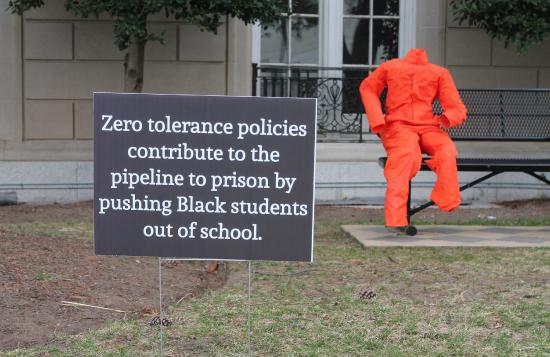
Another reason for more school policing was the Columbine school shooting in 1999. After that tragedy, many people demanded stronger security in schools. But instead of focusing on bullying, mental health, and access to guns, leaders focused on punishment and more armed police. The chapter says this led to more zero-tolerance policies. Zero-tolerance means schools use strict punishment even for small mistakes. This often leads to suspension, expulsion, or arrest for things that used to be handled by teachers or principals. This shows how fear can lead to harsh policies that do not really solve the real problem.
The chapter also talks about high-stakes testing and school reorganization. Schools became more focused on test scores, school rankings, and performance numbers. Because of this, some schools saw struggling students as a problem. Students who performed poorly or acted out were seen as lowering the school’s numbers. So instead of helping them, schools often removed them through suspension, expulsion, or pressure to drop out. This was very sad to read because education should support students who need help the most, not push them away.
The section on testing and suspensions shows how serious this problem became. In North Carolina, suspension rates increased a lot, and Black students were much more likely to be suspended than white students. In Florida, thousands of students were arrested at school, many for minor reasons. In Texas, the reading says suspension rates became extremely high, and most suspensions were for small rule violations. This tells me that students were being punished not for serious danger, but for normal behavior, mistakes, or school rule issues.
The chapter describes some schools as “supermax schools.” This comparison is shocking. These schools used metal detectors, fingerprint scanners, cameras, and strict punishment systems. These tools made students feel like prisoners instead of learners. The reading says these schools had terrible conditions and poor outcomes. This shows that more punishment does not create better education. It only creates fear, stress, and disconnection.
The chapter also criticizes some charter schools for using very strict disciplinary systems. It says some young children, even kindergartners, were suspended. I was surprised by this because kindergarten children are very young. They are still learning how to behave, share, and manage emotions. Suspending them does not teach them in a healthy way. It may only make them feel rejected and confused. The reading suggests that these strict systems can push students out, while schools then claim better graduation rates because difficult students are gone.
Another powerful point in the chapter is the idea of schools as prisons. It says that schools increasingly use metal detectors, cameras, police, zero-tolerance rules, and harsh punishment. This reflects the larger rise of mass incarceration in society. The Gun-Free Schools Act and zero-tolerance rules helped increase student punishment even while crime rates were falling. This means schools became more punitive even when students were not becoming more dangerous.
The reading says there were 92,000 school arrests in the 2011–2012 school year. It also says schools with SROs had five times the arrest rate of schools without them. This is a very important fact. It suggests that police presence does not simply respond to crime. It creates more criminalization. When police are in schools, more student behavior gets treated as a crime.
The chapter explains that the impact is especially harmful for marginalized students. Black, Latinx, Native, disabled, and LGBTQ students are punished more often. Black students were a much smaller part of school enrollment than white students, but they made up a larger share of students referred to law enforcement and arrested. In Chicago, Black students were far more likely to be arrested than white students, even when many were under fifteen years old. Many arrests happened for small things like using a cell phone or talking back to a teacher. This is not about safety. It is about harsh control.
The chapter says schools often rely on police because it seems easier. Instead of building supportive classroom environments, some schools simply call police to remove students. But the reading says creating a positive school climate is cheaper and better than paying for armed officers. This idea makes sense to me. A healthy school needs patience, support, counseling, and strong relationships. Police cannot replace those things.
The section on racially unequal suspensions is also very important. Black male students were suspended much more than white male students. Black female students were also suspended much more than white female students. This shows that girls of color are also strongly affected, even though people often focus only on boys. Native students were also disciplined at much higher rates in places like New Mexico. This proves that the school-to-prison pipeline is a racial justice issue.
The section on girls of color was one of the saddest parts of the reading. Black girls are often seen as disrespectful, loud, or defiant. Because of these stereotypes, they are punished more harshly. The story of Jaisha Aikins, a 5-year-old girl who was handcuffed for a tantrum, was heartbreaking. Five-year-olds are very young. A tantrum should be handled with care and patience, not handcuffs and police. This example shows how early criminalization can begin.
Another painful example was the case of the student in South Carolina who was violently thrown from her desk by a school officer. She was sitting calmly, but the officer used extreme force. Another student who protested was also arrested. These stories show how zero-tolerance policies place student behavior in the hands of armed police. This creates danger instead of safety. It also teaches students that punishment and force are normal responses to disagreement.
The chapter also explains that Native girls are heavily affected. Some are arrested even when they are trying to defend themselves. These cases show that Native youth are also targeted unfairly. The reading helped me understand that the school-to-prison pipeline affects many groups, not only one.
Another important point is the sexual harassment and humiliation faced by girls of color. Some girls experienced inappropriate touching during school security checks. Others were treated badly because of their clothing, hijabs, or immigration status. This made me realize that school policing can also harm students in gendered ways. School should never be a place where girls feel violated or ashamed.
The section on special-needs children was also very emotional. Students with disabilities are referred to law enforcement much more than their share of the student population. The story of Kayleb Moon-Robinson, an 11-year-old Black student with autism, was very upsetting. He was charged with crimes after struggling with a school officer. His mother explained that because of his autism, he did not fully understand the situation. Yet he was treated like a criminal.
The chapter gives even more painful examples, like a 4-year-old being handcuffed and young disabled children being restrained in ways that caused them pain. One child had such small arms that the handcuffs were placed on his upper arms. This is shocking and cruel. Children with disabilities need understanding and support, not violence and criminal charges.
The reading says that once a child is arrested, they may get a record, probation, or court involvement. This can follow them for years. So the school-to-prison pipeline is not only about one punishment at school. It can affect a child’s entire future. This made me think about how important it is to stop criminalization early.
The final part of the chapter discusses the militarization of schools. This means school police are using military equipment, training, and tactics. The examples in this section were very disturbing. In one school, police used a SWAT-style raid, guns, dogs, and searches on mostly Black students, and no drugs were found. In other places, students were pepper sprayed, beaten, tased, or even killed. These are terrible things to happen in schools.
The reading says there is no strong evidence that SROs reduce crime or make schools safer. In fact, students in schools with police often feel less safe. This is very important. It means more police does not automatically create more security. Sometimes it creates more fear, mistrust, and harm.
In conclusion, this chapter taught me that the school-to-prison pipeline is a very serious problem. It shows how schools can stop being supportive places and start acting like parts of the prison system. Zero-tolerance rules, school police, testing pressure, harsh suspensions, and militarized discipline all push many students out of school. This harms students of color, girls of color, Native youth, LGBTQ students, and students with disabilities the most. The chapter made me reflect on what schools should really be. Schools should be places of care, patience, safety, and learning. Children make mistakes, and they need guidance, not criminalization. I agree with the idea at the end of the chapter that young people need compassion and care, not coercion and control.


Punishing Children
Testing and Suspensions
Schools as Prisons

No comments:
Post a Comment