6.5: Migration and Immigration
Reflection Summary on “6.5: Migration and Immigration”
The reading “6.5: Migration and Immigration” explains how migration from Latin America is shaped by history, policy, and power. It also explains that the word “immigrants” often includes Indigenous peoples from Latin America. This is important because many people assume all immigrants from Latin America are only Spanish-speaking Latinos. But the chapter shows that some immigrants are Indigenous and speak Indigenous languages, such as Mixteco. This reading helped me understand that migration is not just moving from one place to another. Migration is connected to economics, war, colonial history, and government policies that can either support or harm people.
The chapter explains a key difference between immigration policy and immigrant policy. Immigration policy is about laws that control how many people can enter and how they can enter. Immigrant policy is about laws that affect immigrants who are already living in the United States. This difference is very important. Many people mix these terms, but the chapter shows they work in different ways. For example, immigration policy includes visa systems and temporary worker programs. Immigrant policy includes enforcement systems and regulations, such as raids, detention, and deportation. This helped me see that someone’s daily life can be shaped more by immigrant policy than by immigration policy. A person may already be living in the U.S., but they still face fear and control through enforcement.
The reading discusses ICE, Immigration and Customs Enforcement. It explains that ICE was formed in 2003 after the creation of the Department of Homeland Security. This happened after the terrorist attacks on September 11, 2001. The chapter explains that ICE replaced the Immigration and Naturalization Service, which was INS. ICE adopted a militarized and policing framework for immigration enforcement. This means immigration enforcement started to feel more like war and punishment than public service. This section made me reflect on how fear can shape policy. When government systems treat immigrants like threats, it creates fear in communities. It also creates distrust of institutions. It can stop people from seeking help, even when they need healthcare or protection.
The chapter explains that some policies try to restrict migration by limiting access. But the chapter also explains that U.S. economic and military policies can encourage migration at the same time. This is important because it shows a contradiction. The U.S. may say it wants to stop migration, but its actions can create conditions that push people to migrate. The chapter explains that people may migrate through dangerous and unauthorized ways because legal pathways are limited. This part of the reading helped me understand that “unauthorized migration” is not only about personal choice. It is often about survival and lack of options.
The reading then explains early U.S. immigration laws. It lists examples like the Immigration Act of 1875, the Chinese Exclusion Act of 1882, and the Immigration and Nationality Act of 1952. The chapter explains that these laws enforced racial and ethnic quotas. These quotas created the idea that migration must be carefully limited. It also shows that the immigration system was shaped by white supremacist ideas. It targeted Black and Brown people by restricting legal migration from certain countries and regions. This section helped me see that immigration policy is not neutral. It has a history of racism. It has been used to shape the nation in a way that benefits white people.
The chapter also notes something ironic and painful. It states that early immigration laws even called for the removal of Native Americans. This shows that U.S. policy has a long history of trying to control who belongs on the land. It also shows how settler colonialism shapes citizenship. Native people were here first, yet the government still tried to remove them. This made me think about how the U.S. has often used law as a tool of displacement. Immigration policy is not only about outsiders. It is also connected to the treatment of Indigenous nations inside the U.S.
The reading explains that even while the U.S. uses restriction, it has also recruited migrants when it needed labor. The chapter gives an example: the Bracero Program from 1942 to 1965. This program legalized migration for individual men to work seasonally on farms. The chapter explains that this created a pattern of cyclical migration. Many men worked in the U.S. while their families stayed in Mexico. They sent back money called remittances. This section made me reflect on how labor systems can use people but not fully accept them. The U.S. wanted workers, but it did not always support their full rights or family unity. This shows how migration can be shaped by economic demand, not human dignity.
The chapter explains that in 1965 the Bracero Program ended. That same year, immigration law was amended and country-of-origin quotas were removed. The reading says this led to an increase in migrants from Latin American countries. The chapter also explains that the U.S. has continued to encourage migration through military and economic campaigns that destabilize Central and Latin American countries. It mentions corruption, crime, and violence, and says these problems are worsened by external interference. This leads vulnerable people to seek protection and opportunity in the U.S. This part of the reading helped me see migration as connected to global power. When powerful countries intervene in other regions, they can create instability. Then people flee. Later those same people can be criminalized for migrating. That is unfair, but it is common in global politics.
The chapter then discusses the Immigration Reform and Control Act (IRCA) of 1986. It says this was a major shift because it offered amnesty to millions of undocumented Mexican migrants living in the U.S. But the chapter also explains it promised more punitive policies in the future. The reading states that since then, policymakers have not made structural changes that create pathways to citizenship or offer broad amnesty again. Instead, the focus has been on recruiting educated and professional immigrants. The chapter calls this “brain drain.” At the same time, immigrant policy has become more punitive and militarized, including border patrol expansion, deportation, detention, and family separation. This section made me think about inequality in immigration. Some immigrants are welcomed because of education and skills. Others are punished even if they work essential jobs. This creates a system where human value is judged by economic benefit.
The chapter also explains how media and politics create stereotypes. It says Latina/o/x immigrants are often portrayed as criminals, invaders, and terrorists. The chapter calls this an “illegalized identity.” This means people are treated as illegal even when they are human beings with families and dignity. The chapter explains that these stereotypes have serious consequences. They increase fear. They increase hate. They also support harsh policies. The reading mentions that in recent years, elected officials like ex-President Donald Trump amplified these stereotypes. The chapter explains this encouraged anti-immigrant groups and emboldened militias who treat the southern border like a war zone. This part of the reading made me reflect on how language creates danger. When leaders use dehumanizing words, people become targets. Communities become unsafe. Fear spreads.
The reading also explains that institutions like ICE create fear by threatening livelihood and family life. It also says racial profiling in immigration enforcement extends fear to Latinx communities and people of color more broadly. This is important because it shows enforcement does not only affect undocumented immigrants. It affects entire communities. People may fear driving, working, or going to school. Children may fear losing parents. This creates long-term trauma. This section helped me see immigrant policy as a public health issue too, because fear and stress affect mental and physical health.
The chapter then shifts to Immigrant Policy and Immigrant Justice. It explains that advocates use creative strategies because many immigrant groups are excluded from political representation and legal rights. Immigrant justice movements work on many issues, not only legal reforms. The chapter says communities also fight for dignity, health, economic justice, and family unity, including mixed-status families. This section mattered to me because it shows immigrant justice is not only about paperwork. It is about human life. It is about being able to live without fear. It is about being able to care for family. It is also about being respected in society.
The chapter explains that immigrant communities include Indigenous peoples from Latin America. These communities may also focus on sovereignty and cultural preservation. This is important because Indigenous migrants face unique challenges. They may face discrimination in U.S. society and also within Latinx communities, especially when language barriers exist. The chapter explains that these movements combine direct action, community support, and policy change at local, state, and federal levels. This shows that justice work is multi-level. People must fight in many places at the same time.
The chapter discusses language barriers as a major issue. It explains that multilingual translation and interpretation are important for inclusion. It gives an example from California: the Mixteco/Indígena Community Organizing Project (MICOP). This organization centers Indigenous language access within immigrant and health advocacy. The chapter explains that MICOP launched Radio Indígena in 2014. The station provides over 40 hours of weekly live programming. It includes multiple Mixteco languages, Zapoteco, and Purépecha. It offers information and entertainment relevant to Indigenous farmworking communities. The chapter gives examples like rental assistance, energy support programs, and family paid leave. This part of the reading stood out to me because it shows practical justice. Language access is not a small issue. It can decide whether people get help or not. It can decide whether people understand their rights. It can decide whether people feel included.
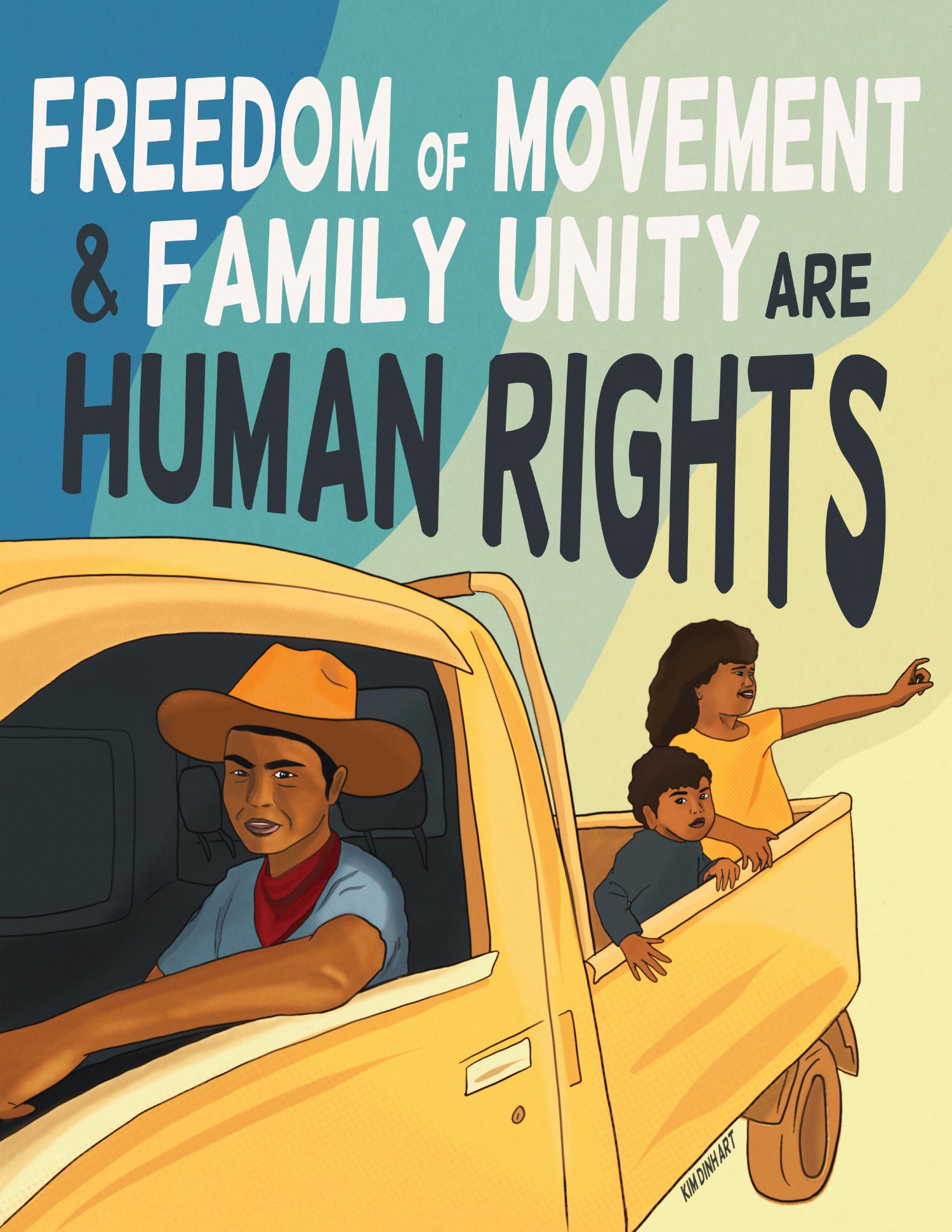
The chapter explains that organizations like MICOP use a human rights framework and holistic support. The reading includes a figure with the phrase “Freedom of Movement and Family Unity are Human Rights.” This message connects to the core point of the chapter. Migration is often treated as a crime. But the chapter asks us to see migration as connected to human needs and human rights. People migrate because they want safety, work, and a future. People also migrate because policies and interventions destabilize their home countries. This is why immigrant justice movements emphasize dignity and family unity.
Overall, this chapter helped me understand migration as a system, not just an individual act. It showed me that U.S. immigration history has been shaped by racism, quotas, and labor demands. It showed me that policies can both recruit and punish migrants at the same time. It also showed me that enforcement systems like ICE create fear and trauma. At the same time, the chapter showed that communities resist. They organize. They build support networks. They create language access. They fight for human rights.
This reading made me reflect on how immigration debates are often simplified in public media. People argue about “legal” and “illegal” as if the system is fair. But the chapter shows that the system has always been shaped by power and inequality. It also shows that migration is connected to U.S. actions abroad. This helped me understand why Chicanx and Latinx Studies is important. It gives tools to analyze the larger structure. It also teaches students to think critically about stereotypes. Most importantly, it reminds us that immigrants are human beings. They have families, cultures, and languages. They deserve dignity, safety, and fair treatment.
Works Cited
Viveros Espinoza-Kulick, Mario Alberto, and Ulysses Acevedo. “6.5: Migration and Immigration.” Introduction to Chicanx and Latinx Studies, ASCCC Open Educational Resources Initiative (OERI), CC BY-NC 4.0.



Overview of Migration
Immigration Policy
Immigrant Policy and Immigrant Justice

No comments:
Post a Comment